🇨🇭 Canton guide
Fribourg: living, going out and working in the canton
Everything about the canton of Fribourg: languages, politics, withholding tax for cross-border workers, transport, food and specialities, museums, bars, festivals, and an interactive map of the Gruyère, Fribourg and Lake Murten.
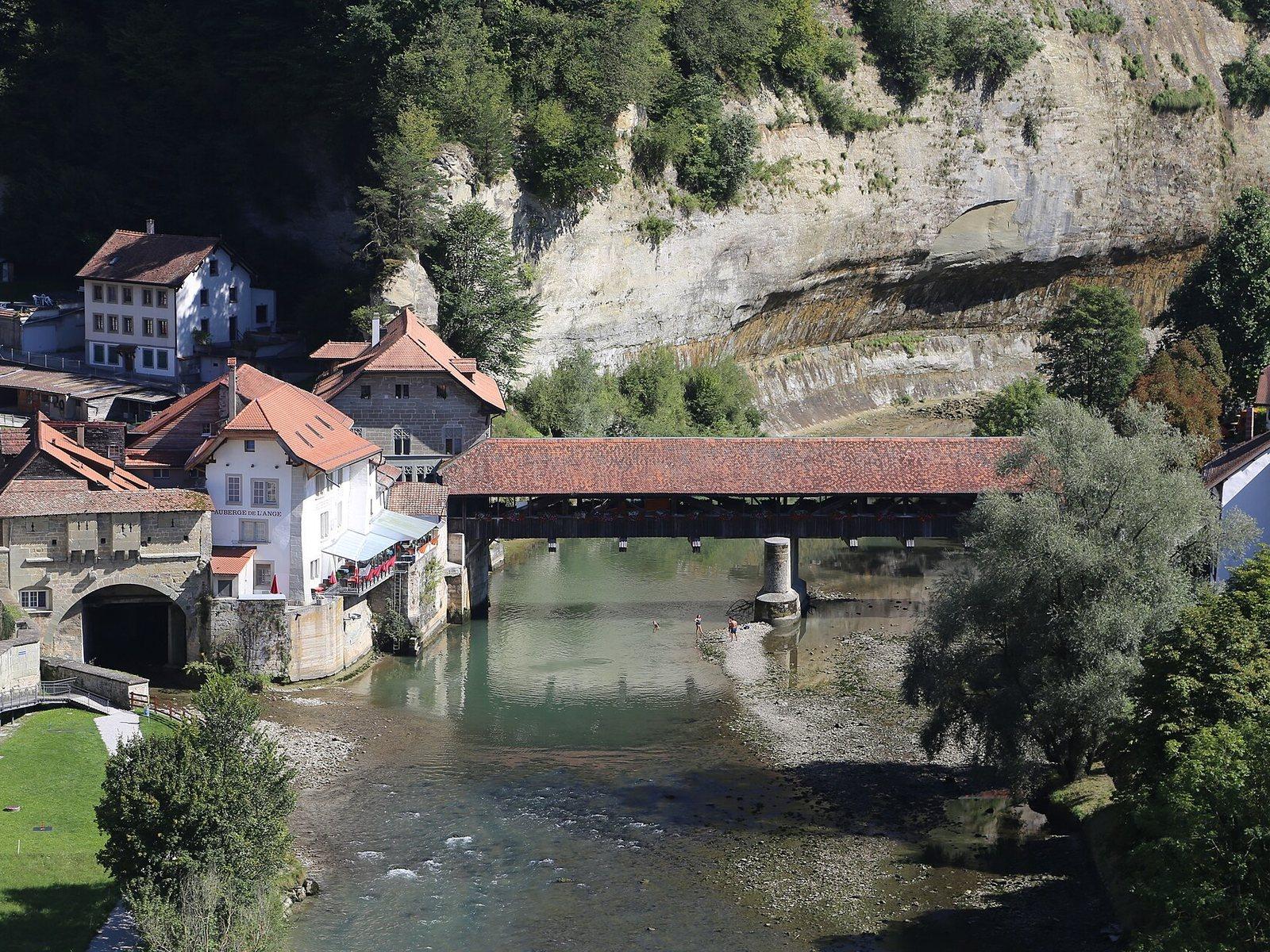
Photo (cropped): Rufus46, CC BY-SA 3.0, via Wikimedia Commons
- residents at the end of 2025 (Statistics and Data Service)
- 350,918
- cross-border workers active in the canton in the second quarter of 2026 (provisional)
- 2,140
- in Switzerland: Fribourg is not one of the eight cantons of the 1983 agreement
- At source
- official languages (Fribourg Constitution, art. 6)
- French and German
10 sections≈ 16 min readSources checked on November 6, 2026
The interactive map
30 places marked: landmarks, museums, transport, restaurants, nights out and events. Tap a point to learn more.
Loading the map…
Places on the map (30)
Base map © swisstopo · Places: © OpenStreetMap contributors. When the map appears, your browser loads the tiles from the servers of the Swiss Confederation (swisstopo), which can see your IP address.
Fribourg is the bilingual canton of the Gruyère, Lake Murten and the Sarine: a university city, medieval castles, Gruyères cheese and the vineyards of the Vully. Above all, it is a canton that is not one of the eight cantons of the 1983 agreement: for a cross-border worker, that means you are taxed at source in Switzerland, as in Geneva, and not in France. It is also the youngest canton in Switzerland, with 21.6% of residents under 20.
This page gathers what you need to know to live, go out and work in Fribourg: languages, politics, tax, transport, food and local specialities, museums, bars, festivals. The figures come from official sources listed at the bottom of the page. Venues open, close and change their hours: always check with them before you travel. The interactive map on the page shows the places mentioned, from the Gruyère to Lake Murten.
1. Fribourg at a glance
| Key point | What to know |
|---|---|
| Capital | The city of Fribourg, Freiburg in German (Constitution, art. 2) |
| Population | 350,918 residents at the end of 2025 (+4,244, or +1.2% in a year; +26.0% since 2010) |
| Foreigners | 25.8% of the population (27.7% for Switzerland as a whole): Portuguese (about 27,700), French (about 15,400), Italians (about 6,100) |
| Age | 21.6% under 20, the youngest canton in Switzerland; 17.5% aged 65 and over |
| Languages | French and German official; in 2024, 68.3% of residents gave French as their main language and 25.1% German |
| Cross-border workers | 2,140 in the second quarter of 2026 (provisional) |
| Tax for cross-border workers | At source, in Switzerland (outside the 1983 agreement) |
| Places that come up often | Fribourg, Gruyères, Bulle, Romont, Murten, Estavayer-le-Lac, Vully |
Population growth in 2025 comes first from the international migration balance (+2,031 people), then from the inter-cantonal balance (+1,201); the surplus of births over deaths is positive but modest (+981).
Cross-border workers: cross-border work was “non-existent or almost” before 2007. In 2026 the canton has 2,140 cross-border workers (+940 in five years, or +78%; +280 over the last year, or +15%). 83% are men, nearly 60% are aged 30 to 49, and more than 80% come from France, mainly Rhône-Alpes and Franche-Comté. They work in services (68%) and industry (31%).
2. Languages
French and German are the official languages of the canton (art. 6). Use is governed by the territoriality principle: the State and the municipalities protect the traditional distribution of languages, and each municipality is French- or German-speaking, sometimes both where there is a significant minority. The State encourages bilingualism.
In practice, the language depends on the district:
| District | Main language (2024) |
|---|---|
| Lac (Murten) | 60.3% German, 36.2% French: the most balanced |
| Singine (Sense) | 85.7% German, 11.1% French |
| Veveyse | 92.3% French, 2.7% German |
| Canton | 68.3% French, 25.1% German |
3. How the canton is governed
The canton lives under the Constitution of 16 May 2004, in force since 1 January 2005; the version read is the one of 1 January 2025.
| Institution | Role | Composition and election |
|---|---|---|
| Grand Council | The parliament | 110 deputies, elected for five years by proportional representation, in at most eight electoral districts (art. 95) |
| State Council | The government | 7 members, elected by majority vote, at the same time as the Grand Council; the whole canton is one constituency; five years, at most three full terms (art. 106); the president is elected by the Grand Council for one year (art. 107) |
The people also elect the prefects of each district (art. 40). Cantonal elections are taking place right now: the City of Fribourg is closing its residents' office on 9 November 2026 “the day after the cantonal elections”.
Popular rights:
- Popular initiative: 6,000 active citizens, signatures to be collected within 90 days (art. 42).
- Optional referendum: 6,000 active citizens, within 90 days, on laws and on major expenditure (art. 46).
- Popular motion: 300 active citizens can send a motion to the Grand Council (art. 47).
Who votes? In cantonal matters, adult Swiss citizens living in the canton (art. 39). In municipal matters, Swiss citizens but also foreigners holding a settlement permit (C permit) who have lived in the canton for at least five years (art. 48). Only people with active citizenship in cantonal matters can sit on the authorities; the law may open judicial posts to foreigners with the same status (art. 86).
4. Working in Fribourg as a cross-border worker
- Tax: at source, in Switzerland. According to the cantonal tax service, the canton of Fribourg is not covered by the agreement of 11 April 1983 (which covers only Bern, Solothurn, Basel-Stadt, Basel-Landschaft, Vaud, Valais, Neuchâtel and Jura). A worker living abroad is taxed at source on their pay by their Swiss employer. The scales capped at 4.5% apply only to cross-border workers from Germany; all other cross-border workers, French ones included, are taxed normally under scales A, B, C, H and G.
- Personal situation: the scale depends on your marital status and number of children at the time of payment. Without reliable information, scale A applies. The tax service states that valid French marriages are treated as spouses, but not the PACS, which is not valid outside France for choosing the scale.
- Remote work (since 1 January 2026, amendment to the France-Switzerland convention): as long as remote work does not exceed 40% of annual working time, all of the salary stays taxable in Switzerland. That limit includes up to 10 days of temporary missions outside Switzerland. Above 40%, remote-working days are taxable in France from the first day, and so are all days of temporary missions. Part-time, the rule applies pro rata: at 50%, one day a week.
- Employer's obligation: from 1 January 2026 it must track the remote-working and mission days of each employee living in France, in order to send the rate to the tax service in January 2027.
- G permit: we have not read the Fribourg cantonal page on the G permit; follow the site's guide and ask your employer.
The cantonal minimum wage: there is none in force in Fribourg. A popular initiative “Pour un salaire minimum” proposed CHF 23 an hour, with automatic indexation, and priority over the minimums in collective agreements; it was put to a vote on 30 November 2025, with the State Council and the Grand Council recommending that it be refused (State's official page). The press reported its rejection (53.54% no): we have not re-read the official result.
- Hospitality collective agreement (CCNT): its minimums run from CHF 3,713 to 5,293 gross per month in 2026 depending on qualification (CHF 4,528 with a CFC), for a full-time job. In Fribourg it is this agreement, or your contract, that sets the minimum for your job.
5. Getting around
| Means | What it is | Good to know |
|---|---|---|
| TPF | The Fribourg public transport company: trains and buses in the canton | Head office in Givisiez; timetables and tickets at tpf.ch |
| Frimobil | The fare community of the canton and the Vaud Broye | 55 zones; tickets, day passes and season tickets (Youth, Adult, Senior, FlexiAbo, JobAbo…) |
| Charmey gondola | To the Vounetz summit | Open “this weekend” according to the Charmey site (6 November 2026); Le Vounetz restaurant at the top |
| Moléson | Funicular and cable car from Moléson-Village | Lift timetables at moleson.ch; open every weekend |
We have not read Frimobil pass prices or SBB timetables towards Haute-Savoie, the French Jura or the Doubs: check before accepting a job.
6. Eating and drinking
Specialities to know
- Gruyère PDO: the Maison du Gruyère in Pringy-Gruyères has a demonstration cheese dairy, “the taste of the Swiss since 1115”, and a restaurant.
- Vacherin fribourgeois PDO: milk production, cheese making and ripening all take place only in the canton; the cows' ration is at least 70% grass and hay from the farm. Registered on 28 February 2006.
- Cuchaule PDO: a saffron brioche-style bread made of wheat flour, whole milk, butter, egg, sugar, salt and yeast; all ingredients come from the canton. Registered on 3 May 2018.
- Poire à Botzi PDO: a pear of a single variety, the “petite poire à grappe”, grown and stored in the canton of Fribourg, in one Bernese municipality and in certain Vaud municipalities. Registered on 5 October 2007.
- Jambon de la Borne PDO: a dry-salted pork ham, cured at least three weeks, cold-smoked over wood; the pigs are born and raised in the cantons of Fribourg and Vaud. Registered on 8 September 2021.
- Murten Nidelkuchen: a leavened cream cake with five layers of cream, made in several Murten bakeries.
- Vully wines: the Vully is “the smallest of Switzerland's major wine regions”: 152 hectares, 24 winemakers, Chasselas (41%), Pinot noir (28%), Freiburger and Traminer; the Vully spreads across Fribourg and Vaud.
- Murten truffle market (14 and 15 November 2026): about twenty exhibitors, fresh truffles and specialities, with a truffle and wine tasting.
Where to taste them
| Address | Where | What you will find |
|---|---|---|
| La Maison du Gruyère | Place de la Gare 3, Pringy-Gruyères | Demonstration cheese dairy, restaurant, Gruyère market; open every day |
| La Pinte du Vieux Manoir | Rue de Lausanne 18, Murten-Meyriez | Restaurant on the lake, terrace and garden |
| Restaurant Ringmauer | Deutsche Kirchgasse 2, Murten | Seasonal dish in a historic restaurant, brasserie |
| Schiff am See | Ryf 53, Murten | Lakeside restaurant, terrace |
| Mc Boar brewery | Route de Payerne 8, Fétigny | Taproom: craft beers brewed on site |
7. What to see and do
Not to be missed
- Gruyères: the castle is first mentioned in 1244; the main residence of the counts of Gruyère, then the seat of Fribourg bailiffs from 1555 to 1798, it became an artists' residence in the 19th century (the Bovy family). It is open every day.
- Murten: the castle was built in 1255 by Count Peter II of Savoy; the Berne gate, mentioned as early as 1239, and the ramparts enclose a baroque old town with arcades, beside the lake. The Murten museum traces 6,000 years of history; the Cave Couronne 1669 can be visited.
- Estavayer-le-Lac: the Chenaux castle, whose keep (building began in 1284) is exceptionally open, and the Frog Museum, with 108 frogs stuffed in the mid-19th century.
- Fribourg: the Museum of Art and History (MAHF) and the Espace Jean Tinguely – Niki de Saint Phalle, on Rue de Morat.
- Romont: the Vitromusée, the Swiss museum of stained glass and glass art.
- The Moléson (funicular, cable car, bobsleigh run, via ferrata) and Charmey (Vounetz gondola).
- Mont Vully (653 m): a unique panorama over the Alps, the Jura and the Three Lakes; La Nouvelle Plage in Estavayer-le-Lac offers cable skiing.
- Gletterens: a reconstructed lake village, with workshops on prehistoric life (4500 to 800 BC).
Museums
| Museum | What you will see |
|---|---|
| Museum of Art and History (MAHF), Fribourg | The canton's cultural history, permanent display and temporary exhibitions; Espace Jean Tinguely – Niki de Saint Phalle |
| Vitromusée, Romont | Swiss museum of stained glass and glass art |
| Murten Museum | 6,000 years of history of the town and its region, in the former town mill |
| Cave Couronne 1669, Murten | A cellar at Rathausgasse 5, with traces of Murten's Middle Ages |
| Estavayer-le-Lac Museum and its frogs | 108 stuffed frogs in staged scenes |
| Lake village, Gletterens | A reconstructed prehistoric village |
| Vallon Roman Museum | Mosaics and wall paintings of the Roman heritage, on an archaeological site |
The Musée gruérien in Bulle closed in February 2025 for works; its reopening is planned for spring 2028.
8. Bars, cellars and nights out
No official list of clubs or discos could be read for Fribourg: the section relies on the Murten bars listed by the Jura & Trois-Lacs site and on the Nouveau Monde. The list is not exhaustive: nightlife venues open and close quickly.
| Address | Type | Where |
|---|---|---|
| Läif Musik Bar | Murten's “cult” bar, small dance floor, open stage | Hauptgasse 37, Murten |
| Muratum Bar & Lounge | Bar reopened after 20 years of closure, four rooms | Hauptgasse 43, Murten |
| BB Bar et Lounge | Tapas late into the night; open until 2.30 am on Friday and Saturday | Bernstrasse 7, Murten |
| Beach House | Lakeside bar, May to October | Hotel Bad Muntelier, Hauptgasse 5 |
| Le Nouveau Monde | Cultural venue at the Ancienne Gare: café, shows, exhibitions, screenings, meetings | Esplanade de l'Ancienne-Gare 3, Fribourg |
9. Festivals and highlights
| Event | When | What it is |
|---|---|---|
| Murten truffle market | 14 and 15 November 2026 | About twenty exhibitors in the old town |
| Nova – Les rendez-vous de l'hiver | 26 November to 23 December 2026 | Third edition, Place Georges-Python, Fribourg |
| Noël le Magnifique | 21 November 2026 to 10 January 2027 | Exhibition at Gruyères castle |
| Murten Festival of Lights | 20 to 31 January 2027 | Twelve evenings of light installations in the old town |
| Estavayer Carnival | 29 to 31 January 2027 | Three days of confetti, masks and parades |
| FIFF | 12 to 21 March 2027 | Fribourg International Film Festival |
| Roses Festival | 11 to 13 June 2027 | Estavayer-le-Lac: flowered lanes, concerts, market |
| Murten Classics | Every year, summer | Since 1989, more than 30 concerts in and around Murten; 2027 date not read |
| Estivale Open Air | Every year | Since 1991, an open-air music festival in Estavayer-le-Lac; 2027 date not read |
| Vully Blues Festival | Every year | Blues in six cellars of the village of Praz; 2027 date not read |
Sources
- Constitution of the canton of Fribourg (RSF 10.1): version in force since 1 January 2025; art. 2, 6, 39, 40, 42, 46, 47, 48, 86, 95, 106, 107.
- Statistics and Data Service (SSD) of the State of Fribourg: population, migration and integration, languages and religions, cross-border workers.
- Cantonal tax service: “withholding tax” instructions from 2025 and taxation of remote work for cross-border workers; withholding tax page.
- Popular vote of 30 November 2025: initiative “Pour un salaire minimum” (State of Fribourg).
- Site guides, checked against official sources: G permit, contract and pay (CCNT).
- Swiss Association of PDO-PGI: cuchaule, Poire à Botzi, Jambon de la Borne.
- Websites of the places: Gruyères Castle, La Maison du Gruyère, MAHF, Vitromusée Romont, Musée gruérien, Moléson, Charmey, Nouveau Monde, FIFF, City of Fribourg.
- TPF and Frimobil: network and fares.
- Jura & Trois-Lacs (Lake Murten and Estavayer-le-Lac region): Murten, Estavayer-le-Lac, Vully and the page of each place.
- Map coordinates: © OpenStreetMap contributors, checked address by address where the address is known; base map © swisstopo.
Want to work in Fribourg?
Browse the canton's job listings, or discover the programme that prepares you for the application, the interview and the employment contract.
Switzerland — all 26 cantons