🇨🇭 Canton guide
Geneva: living, going out and working in the canton
Everything about the canton of Geneva: languages, politics, transport, food and specialities, museums, clubs, festivals, minimum wage, and an interactive map of the places to know.
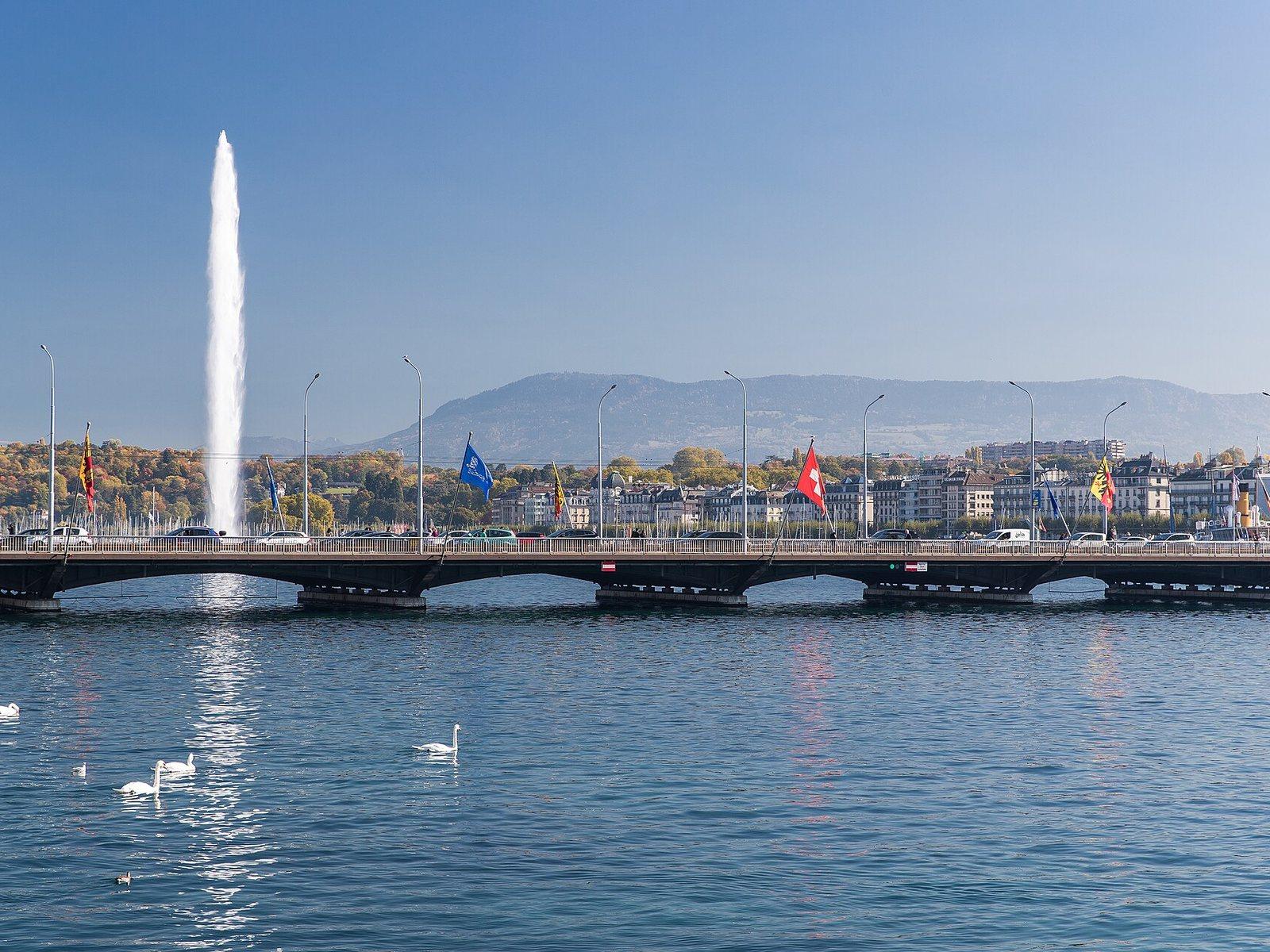
Photo (cropped): Emmanuel Berrod, CC BY-SA 4.0, via Wikimedia Commons
- residents at end of June 2026 (OCSTAT)
- 537,935
- active cross-border workers in 2025 (provisional, OCSTAT)
- 116,796
- minimum gross hourly wage since 1 January 2026
- CHF 24.59
- official language (Geneva Constitution, art. 5)
- French
10 sections≈ 17 min readSources checked on November 6, 2026
The interactive map
46 places marked: landmarks, museums, transport, restaurants, nights out and events. Tap a point to learn more.
Loading the map…
Places on the map (46)
Base map © swisstopo · Places: © OpenStreetMap contributors. When the map appears, your browser loads the tiles from the servers of the Swiss Confederation (swisstopo), which can see your IP address.
Geneva is a city-canton: a compact urban area on Lake Geneva and the Rhône, home to more than half a million people. For anyone working in hospitality it is the canton that employs the most cross-border workers in Switzerland, and a place with both a lot of addresses to know and several rules to understand before you sign.
This page gathers what you need to know to live, go out and work in Geneva: languages, politics, transport, food and specialities, museums, clubs, festivals. Every figure comes from an official source cited at the bottom. Venues open, close and change their hours: always check with the venue before you travel. The interactive map on the page marks the places mentioned.
1. Geneva at a glance
| Fact | What to know |
|---|---|
| Capital | Geneva |
| Population | 537,935 residents at the end of June 2026 (OCSTAT) |
| Foreign nationals | 42% of the population (2025) |
| Active cross-border workers | 116,796 in 2025 (provisional, +2.4% in a year): 74% live in Haute-Savoie, 19% in the Ain, 7% elsewhere |
| New G permits | 21,958 in 2025, about 2,900 fewer than in 2024 |
| Official language | French (Geneva Constitution, art. 5) |
| Neighbourhoods that come up often | Old Town, Pâquis, Eaux-Vives, Plainpalais, Jonction, Carouge |
According to an official document of the Grand Council, Geneva is the largest employer of G-permit cross-border workers in Switzerland. That is what makes the canton special: a large share of the people who keep its kitchens and dining rooms running do not live there.
2. Languages
French is the canton's only official language: article 5 of the Geneva Constitution says so in one sentence (“The official language is French”). It is the language of the administration, of public schools and of the employment contracts you will sign.
With 42% foreign nationals among its residents, Geneva is nevertheless a place where very many languages and nationalities mix, on the street as well as in international hotels and restaurants.
3. How the canton is governed
Geneva is both a canton and a republic, with its own institutions set by its Constitution.
| Institution | Role | Composition and election |
|---|---|---|
| Grand Council | The parliament: it votes the laws and the budget | 100 members, elected every 5 years by proportional representation (art. 81) |
| Council of State | The government | 7 councillors, elected every 5 years by majority vote (art. 102); each heads a department; the presidency changes every year on 1 June |
Popular rights let residents propose or reject texts:
- Constitutional initiative: 2% of those with political rights can propose a revision of the Constitution (art. 56).
- Legislative initiative: 1.5% can propose a law to the Grand Council (art. 57).
- Optional referendum: 1.5% can ask for a law to be put to a popular vote (art. 67).
- Mandatory referendum: every revision of the Constitution goes to a vote (art. 65).
Foreign nationals aged 18 or over with at least 8 years of legal residence in Switzerland can vote, stand for election and sign initiatives at municipal level (art. 48, para. 3).
4. Working in Geneva as a cross-border worker
- Cantonal minimum wage: CHF 24.59 gross an hour since 1 January 2026. It is adjusted every year to the Geneva consumer price index (State of Geneva announcement of 1 October 2025). Agriculture and floriculture have a separate minimum (CHF 18.07 in 2026).
- The hospitality collective agreement (CCNT). It sets its own minimums, from CHF 3,713 to 5,293 gross a month in 2026 depending on qualification (CHF 4,528 with a CFC). This is a separate rule from the Geneva minimum: we do not decide which one applies to each job. Compare with your contract and, if needed, ask the cantonal Office for Labour Inspection and Relations (OCIRT).
- Tax. In Geneva you are taxed at source in Switzerland: your employer withholds the tax every month, with no certificate to hand over (the 2041-AS certificate concerns the eight cantons of the 1983 agreement, which Geneva is not part of). The canton pays France 3.5% of the gross payroll of cross-border workers living in the Ain and Haute-Savoie (agreement of 29 January 1973): this has no direct effect on your salary or your tax.
- G permit. In Geneva the application is filed online; the permit is then sent to the employer, in 12 weeks on average. A change of employer must be reported within 14 days; if you change your canton of work, the permit lapses and a new application is needed.
- Remote working. Outside the eight cantons of the 1983 agreement, which include Geneva: as long as you stay under 40% remote working, your whole salary remains taxable in Switzerland; beyond that, the share of salary corresponding to remote work becomes taxable in France from the first day worked remotely.
5. Getting around
Geneva has an advantage for cross-border workers: a single fare network, the unireso community, whose zone 10 covers the whole territory of the canton. It was created by SBB, the tpg and the Mouettes genevoises together with the canton, the transport authority.
| Mode | What it is | Good to know |
|---|---|---|
| Trams and buses (tpg) | The Transports publics genevois network covers the whole city | Each ticket is valid for 1 hour; you do not validate it when boarding, but keep it in case of inspection |
| Mouettes genevoises | The yellow shuttle boats that cross the harbour | You can board with a bus or tram ticket |
| Trains (SBB) | Departures from Genève-Cornavin station to the rest of Switzerland and abroad | Timetables on the SBB website |
| Léman Express | Cross-border rail network opened on 15 December 2019 | At opening: 45 stations and 230 km of lines, including 19 stations and halts in the canton |
| Airport | The station is under the terminal | 7 minutes to the centre, up to 7 trains an hour at peak times; 12 tpg lines also serve the airport |
| Cycling | Bike hire and cycle paths | Outside the public transport network |
From France: without changing at Cornavin, Léman Express trains link Geneva (main station and airport) to Annemasse, Annecy, Bonneville, Cluses, Évian-les-Bains and Saint-Gervais-les-Bains–Le-Fayet. The core of the network, between Geneva and Annemasse, opened with six trains an hour in each direction, through five new stations including Lancy-Pont-Rouge and Genève-Eaux-Vives.
A few price markers: on 6 November 2026 the airport website gives CHF 3 for a zone 10 ticket from the airport to Cornavin, and a CHF 10 discount on train tickets to or from the airport. Unireso annual passes cover bus, tram, train and Mouette, with discounts on cultural and sports outings. Fares change often: check them on unireso.com.
6. Eating and drinking
The specialities to know
- The longeole PGI: a raw, unsmoked sausage made of pork, fat and rind, flavoured with fennel seeds and white pepper. It must be poached for 2½ to 3 hours in simmering water. It obtained its protected geographical indication in 2009; it is made in the canton of Geneva, from pigs born, raised and slaughtered in Switzerland. It is often served with green lentils.
- The Geneva thorny cardoon PDO: a ribbed vegetable grown only in the canton. Its origin goes back to the Protestants who took refuge in Plainpalais after the revocation of the Edict of Nantes in 1685; it is now the last place in Europe still growing cardoon with thorns. It is traditionally eaten at Christmas, with chicken or longeole. Its taste recalls artichoke.
- Lake fish: perch fillets, lake trout and pike quenelle appear on seasonal menus.
- Fondue, which Geneva Tourism also presents “by the lake”.
- Chocolate: the city's first chocolate factory dates from 1826. Specialities named: Nougalines, Avelines, Poubelles genevoises and Amandes Princesses.
- Wine: wine bars serve wines from the canton and French-speaking Switzerland.
Where to try them
| Address | District | What you find there |
|---|---|---|
| Café Papon | Old Town | Traditional seasonal cooking in an 18th-century building: lentils, woolly pig cheek, Nant d'Avril poultry, lake trout, longeole |
| La Bise | Old Carouge | Homemade, seasonal, local cooking: breaded Tomme Vaudoise, IGP longeole with green lentils, local charcuterie; a 100% Swiss wine list |
| Café des Négociants | Carouge | A bistro of classic dishes: GRTA pork chop, snail cassolette, frog legs, rum baba; about 100 wines |
| Le Bistroquet | Acacias | Bistronomic cooking on short supply chains: GRTA eggs, perch fillets |
| Bistrot des Halles de Rive | Halles de Rive | Swiss specialities and local producers' goods: Lake Geneva pike quenelle, IGP longeole |
| Inglewood | Eaux-Vives and Plainpalais | Burgers made with fresh, local produce from regional artisans, with a “Burger of the Month” |
Geneva Tourism also names Café des Sources, Café du Marché (Carouge) and Le Lyrique. The canton has 13 starred restaurants, and Geneva Tourism's “Geneva Food Guide” gathers 60 addresses (PDF and map on geneve.com).
7. What to see and do
The essentials
- The Jet d'Eau: a fountain 140 metres high that shoots 500 litres of water per second at 200 km/h. It is the emblem of the harbour.
- The Flower Clock: created in 1955 in the Jardin Anglais by the lake; its design changes with the seasons.
- The Reformation Wall: in the Parc des Bastions, a monument to the Protestant Reformation, with Calvin, Farel, Beza and Knox at the centre.
- The Old Town and St Pierre Cathedral: cobbled streets, squares and old buildings; you can climb the cathedral's towers by 157 steps.
- Carouge: a neighbourhood next to the centre with Mediterranean-inspired architecture, independent boutiques and cafés.
- Pâquis: the district described as “cosmopolitan and lively”, by the lake, with the Bains des Pâquis.
Museums
| Museum | What you see |
|---|---|
| Museum of Art and History | Opened in 1910, one of Switzerland's three largest museums: archaeology, applied arts, fine arts |
| Ethnography Museum (MEG) | In the Plainpalais district: the major issues facing human societies, seen from a global perspective |
| International Red Cross and Red Crescent Museum | Humanitarian action and its relevance today, through exhibitions and events |
| International Museum of the Reformation | In an elegant Old Town townhouse next to the cathedral: the history of the Reformation across nine rooms |
| Musée Ariana | An architectural landmark, known for its vaulted star-filled ceiling and the colonnades of its great hall |
| Maison Rousseau et Littérature | Jean-Jacques Rousseau, presented through his paradoxes rather than as a fixed monument |
| Contemporary Art Centre Geneva | Founded in 1974: contemporary art exhibitions, reflection and dialogue |
| Patek Philippe Museum, Museum of Natural History, Maison Tavel | The Patek Philippe watchmaking museum, natural sciences, the city's history and heritage |
Science and international institutions
- CERN Science Gateway (Meyrin): a discovery centre for particle physics, with exhibitions, shows and workshops. Admission is free, but registration is required. Open Tuesday to Sunday, 9 am to 5 pm (last entry 4:30 pm); closed Mondays and on 24, 25 and 31 December 2026 and 1 January 2027.
- Palais des Nations: seat of the United Nations Office at Geneva. Guided tours are booked online; dates for the following month are released on the 20th of each month, and places go fast. Arrive 30 minutes early; a valid passport from a UN Member or Observer State is required (Schengen-area ID cards are accepted). The palace is under renovation: the route may change.
8. Clubs, bars and nights out
Geneva Tourism and the Electron festival together name most of the Geneva scene. The list is not exhaustive: nightlife addresses open and close quickly.
| Address | Type | Where |
|---|---|---|
| 21 Club | Restaurant, cocktail bar and club inspired by 1920s New York; recently opened | Eaux-Vives |
| Maison Balkii | Cocktail bar, with the Studio b club in the basement | Rue Henri-Blanvalet |
| Chez Calvin | Brasserie in a 1909 building, copper bar, live entertainment from 10:30 pm | Eaux-Vives |
| Chez Lolo | Restaurant and cocktail bar facing the lake, weekend entertainment | By the lake |
| Le Baroque Club | Club open since 1993, baroque decor, resident DJs | Place de la Fusterie |
| Chez Jean-Luc | Bar-club in a vaulted cellar, raw and timeless atmosphere | Rue de la Cité |
| Baroque Restaurant | Restaurant with Mediterranean and Japanese dishes, with a light show after dark | Passage des Lions |
| Leopard Bar | Lakeside bar (Hôtel d'Angleterre), cocktails, concerts, cigar room | Quai du Mont-Blanc |
| Le Frigo | Speakeasy hidden behind a refrigerator door in the restaurant Bleu Nuit | Jonction |
| Village du Soir | Club listed by Geneva Tourism | Lancy |
| Rooftop°42, Bambou Speakeasy, Les Sales Gosses, Bottle Brothers | Other addresses listed by Geneva Tourism | Geneva |
The programme of the Electron festival (October 2026) also names venues and bars across the city:
- Clubs and concert venues: Palladium, Alhambra, Le Zoo, La Gravière, Motel Campo, PTR L'Usine, Le Grand Bain, La Comédie de Genève.
- Bars and small venues: Cosmic Café, La Pépite, Café Gavroche, Kulture Bar, Bar du Nord, Odys Bar, PAV Bar, La Petite Reine, Le Passage, Foound, Ernest.
9. Festivals and highlights
| Event | When | What it is |
|---|---|---|
| Escalade | 11 to 13 December 2026 | “Geneva's most popular historical festival”, linked to the attack of 1602 (see below) |
| Noël au Quai | 19 November to 24 December 2026 | Geneva's main Christmas market, Quai du Mont-Blanc by the lake: mulled wine, chalets, fondue; free entry |
| Electron | 2 to 25 October 2026 | The electronic cultures festival: club nights, live and audiovisual performances, talks, installations, a bar-to-bar night |
| La Bâtie – Festival de Genève | 50th edition in 2026 (18 days of festivities, at the end of summer) | Performances, shows, concerts and parties |
| Antigel | 17th edition in 2027; usual period: early February | Arts festival spread across several municipalities and venues in the canton |
| GPHG (Grand Prix d'Horlogerie de Genève) | 30 October to 15 November 2026 | Exhibition of the 84 timepieces in competition, with workshops and visits, at the Museum of Art and History |
| ANIMATOU | Until 7 November 2026 | Contemporary animation festival |
| Salon du Design | 7 and 8 November 2026 | Listed in the City of Geneva agenda |
The Escalade, day by day (2026)
The Escalade commemorates the attack of 1602 on the city. Programme of the 2026 edition, set by the Compagnie de 1602:
- Friday 11 December: commemorative procession honouring the victims, starting at 6:25 pm on Rue des Chaudronniers.
- Saturday 12 December: lantern procession, starting at 7:45 pm at 1 Rue de l'Évêché, arriving at 8:25 pm at Cour Saint-Pierre; open to everyone, lanterns on sale from 6:30 pm.
- Sunday 13 December: grand historical procession, starting at 5 pm at Parc des Bastions, arriving around 8:30 pm at Cour Saint-Pierre.
- During the day: forging and horseshoeing demonstrations, ladder-climbing, musket and sword demonstrations. Watching the processions is free.
- At the Marché Peneysan (Ancien Arsenal): pastries, bread, cheese, hot drinks, chocolate cauldrons and traditional soup.
Musket fire is loud: hearing protection is advised, especially for children. Some demonstrations depend on the weather.
Other recurring events (usual periods, to be confirmed)
According to the Geneva Welcome Centre, whose dates come from the 2017 to 2020 editions: Museum Night (mid-May, about 30 museums open in the evening), Open Wineries Day (late May, more than 90 wineries), Fête de la Musique (late May to mid-June, mostly free), Ciné Transat (free open-air cinema in the Perle du Lac park, in summer), Geneva Marathon (in spring), Nuit des Bains (evening opening of the galleries in the Bains district). These dates change every year: check the Geneva Tourism calendar.
Sources
- Constitution of the Republic and canton of Geneva (A 2 00): art. 5 (language), 48, 56, 57, 65, 67, 81, 102.
- Council of State, ge.ch: 7 members, 5 years, presidency renewed every 1 June.
- OCSTAT, population and OCSTAT, cross-border workers: 537,935 residents, 42% foreign nationals, 116,796 cross-border workers, 21,958 G permits.
- Grand Council of Geneva, written question QUE 2256: Geneva, first employer of G-permit cross-border workers in Switzerland.
- State of Geneva, “Le salaire minimum genevois 2026 s'établira à 24.59 fr. de l'heure” (1 October 2025).
- Site guides, checked against official sources: cross-border tax (including ge.ch, 3.5% financial compensation), G permit, contract and salary (CCNT).
- unireso: zone 10; Geneva Airport, by train and by public transport; State of Geneva, Léman Express inauguration.
- Geneva Tourism: top 10 things to do, museums, nightlife, local food, Geneva Food Guide, public transport, Escalade, what's on.
- Swiss AOP-IGP Association, Geneva thorny cardoon leaflet; Genève Terroir, longeole guide; Genève Terroir, GRTA label.
- Festivals: Antigel, La Bâtie, Electron; Geneva Welcome Centre, events.
- CERN Science Gateway and opening hours; UN Geneva, visits.
- Map coordinates: © OpenStreetMap contributors, checked address by address; base map © swisstopo.
Want to work in Geneva?
Browse the canton's job listings, or discover the programme that prepares you for the application, the interview and the employment contract.
Switzerland — all 26 cantons