🇨🇭 Canton guide
Lucerne: living, going out and working in the canton
Everything about the canton of Lucerne: institutions, tax for cross-border workers (outside the 1983 agreement), transport, specialities, museums, the Kapellbrücke, festivals, nightlife, and an interactive map.
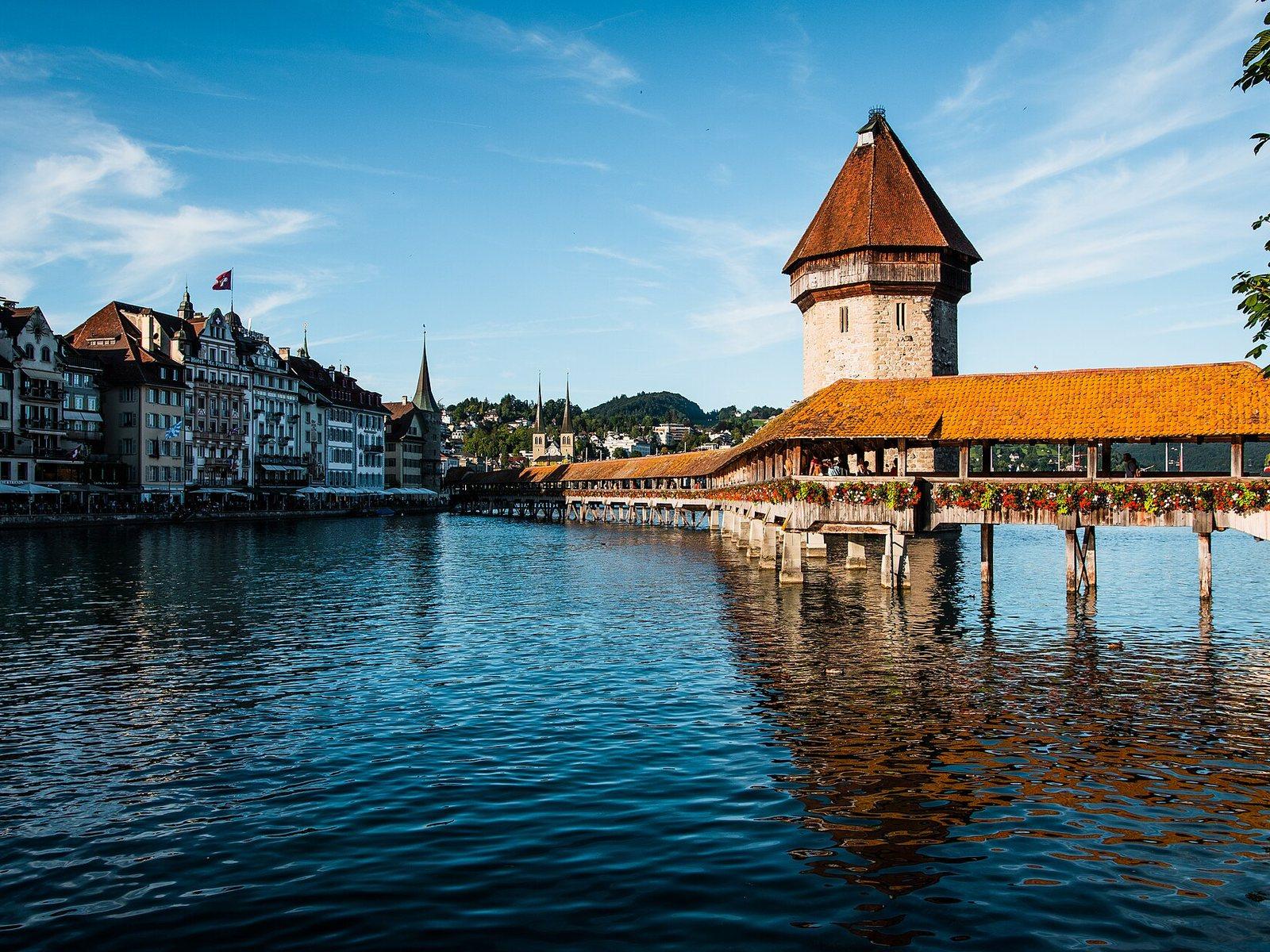
Photo (cropped): Deralpinbergsteiger, CC BY-SA 4.0, via Wikimedia Commons
- residents at the end of 2025 (Federal Statistical Office)
- 441,500
- of the population are foreign nationals (calculated, end of 2025)
- 21.9%
- in Switzerland: the canton is not in the 1983 agreement
- At source
- the only official language (Constitution, § 7)
- German
10 sections≈ 14 min readSources checked on November 6, 2026
The interactive map
48 places marked: landmarks, museums, transport, restaurants, nights out and events. Tap a point to learn more.
Loading the map…
Places on the map (48)
Base map © swisstopo · Places: © OpenStreetMap contributors. When the map appears, your browser loads the tiles from the servers of the Swiss Confederation (swisstopo), which can see your IP address.
Lucerne is a canton in Central Switzerland of 441,500 inhabitants, built around the city of Lucerne, its lake and its wooden bridges, but it also covers the countryside of the Seetal, the Willisau Hinterland, Lake Sempach and the UNESCO Entlebuch Biosphere. It is divided into six electoral constituencies (Wahlkreise). It has no border with France and is not one of the eight cantons of the 1983 agreement: for a French cross-border worker this means being taxed at source in Switzerland, at the ordinary rates, and not in France as in Basel or Neuchâtel.
This page gathers what you need to know to live, go out and work in the canton of Lucerne: language, institutions, tax, transport, food and specialities, museums, nature, nightlife, festivals. The figures come from official sources listed at the bottom of the page. Venues open, close and change their hours: always check with them before you travel. The interactive map further down shows the constituencies and about fifty places, mostly in the city of Lucerne.
1. Lucerne at a glance
| Marker | What to know |
|---|---|
| Population | 441,500 inhabitants at the end of 2025 (permanent resident population) |
| Foreign nationals | 96,796 people, i.e. 21.9%; 344,704 Swiss |
| Constituencies (Wahlkreise) | Luzern-Land (113,135 inhab.), Luzern-Stadt (86,699), Sursee (80,894), Hochdorf (77,831), Willisau (58,387), Entlebuch (24,554) |
| Capital | City of Lucerne (Constitution, § 9) |
| Towns named on this page | Lucerne (86,699 inhab., 28.2% foreign), Sursee (11,118, 19.0%), Hochdorf (10,158, 23.2%), Willisau (9,297, 15.6%) |
| Government | Regierungsrat of 5 members, elected by majority vote (§ 51) |
| Parliament | Kantonsrat of 120 members, elected by proportional representation (§ 36 and 19) |
| Tax of the French cross-border worker | At source in Switzerland (outside the 1983 agreement) |
| Places that come up often | Lucerne, Kapellbrücke, KKL, Rotsee, Sursee, Willisau, Entlebuch |
The percentage of foreign nationals is calculated from the figures in the Federal Statistical Office table "Resident population" (2025); the figures by constituency and municipality come from the same table. The Constitution is dated 17 June 2007; the version read is the one published in the systematic collection as of 1 July 2014, and later amendments are possible.
2. Language
Article 7 of the Constitution is unambiguous: "the official language is German". The canton of Lucerne is therefore German-speaking: the employment contract, payslip, official decisions and forms are generally in German, with Swiss German spoken. The tourist board of Lucerne publishes its website in German, English and French, but the official documents of the state are in German.
No main-language statistic was read: we therefore give no percentage of French speakers. For formalities, count on German or English; an employer in hospitality in the city centre is often used to guests of all languages, but this is not a rule.
3. How the canton is governed
| Institution | What the Constitution says |
|---|---|
| Right to vote | Swiss citizens with political residence in the canton and the right to vote in federal matters (§ 16); it also includes the right to sign initiatives and referendums (§ 17) |
| Kantonsrat (Cantonal Council) | 120 members (§ 36), elected by proportional representation in at least five constituencies (§ 19); the canton has six |
| Regierungsrat (government) | 5 members elected by majority vote, in a single constituency (§ 51); the president chairs the board |
| Term of office | Four years (§ 31) |
| Constitutional initiative | 5,000 voters (§ 20) |
| Legislative initiative | 4,000 voters (§ 21); one year to collect signatures (§ 22) |
| Mandatory referendum | Notably for amendments to the Constitution and free-to-decide spending above CHF 25 million (§ 23) |
| Optional referendum | For laws and spending of CHF 3 to 25 million, on request of 3,000 voters or a quarter of the municipalities, within 60 days (§ 24 and 25) |
| Organisation of the territory | The territory is divided into municipalities and electoral constituencies (§ 6) |
The government sits in the Ritter Palace (Ritterscher Palast) on the Bahnhofstrasse, a Renaissance building handed to the Jesuits in 1577 and used as the seat of the cantonal government since 1804. A cross-border worker has no right to vote in the canton: they vote in neither cantonal elections nor cantonal ballots.
4. Working in Lucerne as a cross-border worker
| Point | What we read |
|---|---|
| 1983 agreement | The Federal Council signed it on behalf of Bern, Solothurn, Basel-Stadt, Basel-Landschaft, Vaud, Valais, Neuchâtel and Jura: Lucerne is not one of them |
| Fribourg tax office | According to its instructions, the agreement "concerns only" these eight cantons |
| Aargau | Its tax office describes the situation of a canton outside the agreement: French cross-border workers taxed at the ordinary rates (A, B, C, H), with a tax credit in France |
| Lucerne tax office | Dienststelle Steuern, Quellensteuer, Buobenmatt 1, 6002 Lucerne; telephone +41 41 228 57 33; "Quellensteuer" page with FAQ, tariffs, forms and online reporting for employers |
| Who pays at source | Foreign nationals without a settlement permit (permit C) resident in the canton; permit C holders whose main tax residence is abroad are also taxed at source |
| Telework factsheet | On 27 June 2023, Switzerland and France signed an additional agreement to the 1966 convention: work done in France up to 40% of working time per calendar year is treated as done at the employer's place in Switzerland; above that, Switzerland in principle may tax only the days worked in Switzerland |
| Employer's duties | They must report the telework rate every year; since 1 January 2026 they must issue on request a certificate for employment during the year (Art. 5a of the source-tax ordinance) |
| Cantonal minimum wage | Not read; check the collective agreement of your sector (see our guide on the CCNT) |
| Number of cross-border workers | Not read |
The cantonal telework factsheet states that the additional agreement applies to the whole of Switzerland. It counts as telework days the days spent at home or elsewhere in France, plus up to 10 days of business trips, all within the 40% limit. The detail of your case (tax scale, deduction, 45 days, health insurance) depends on your situation: follow our guides rather than this page.
5. Getting around
| Means | What we read |
|---|---|
| Passepartout | Fare network of the cantons of Lucerne, Obwalden and Nidwalden: one ticket for bus and train across the whole region, with single ticket, day pass and multi-day pass |
| New bus network | From 13 December 2026, a new bus network (new timetable, new lines) comes into service in the city and agglomeration of Lucerne |
| Lucerne station | Glass-and-concrete hall by Santiago Calatrava, inaugurated in 1991 after the fire of 1971 |
| Boats | The Lake Lucerne Navigation Company (SGV) runs five historic paddle steamers and 15 motor ships to Flüelen, Küssnacht or Alpnachstad |
| Sonnenberg | The "blaues Bähnli" funicular (1902) links Kriens to the Sonnenberg from mid-April to 1 November; otherwise VBL bus no. 10 to Obergütsch, then a 20 to 30 minute walk |
| Bus 1 or 19 | From the station to the Löwenplatz stop (Löwendenkmal, Gletschergarten, Bourbaki Panorama) |
We did not read a detailed line map, timetables or fares. Check your journey on the SBB website and on the Passepartout website before choosing where to live; from 13 December 2026 some bus lines change.
6. Eating and drinking
| Place | What we read |
|---|---|
| Restaurant Stadtkeller (Sternenplatz 3) | Food, the house's own beer and music in the Stadtkeller atmosphere |
| Neubad (Bireggstrasse 36) | Bistro and restaurant in the former indoor swimming pool in the Neustadt |
| suite (Pilatusstrasse 1) | Rooftop bar and restaurant: small plates and cocktails |
| Café Amrein Chocolatier (Hauptgasse, Willisau) | The "original house" of the Willisauer Ringli, a hard biscuit with small white dots made to Heinrich Maurer's recipe; 40-minute workshop visit, from CHF 19 per person; seminar on the Luzerner Lebkuchen |
| DIWISA (Menznauerstrasse 23, Willisau) | Distillery that began in 1918 with the "Träsch" for the Kafi Luz; 2-hour tour with tasting, from CHF 40 per person |
| Hecht Distillerie (Sempach) | Guided Kafi Luz tasting: 30 minutes, CHF 8, at least three people, registration required |
| Lindt Chocolate Experience | Interactive chocolate experience in Lucerne (address not read) |
| Specialities | Kafi Luz (coffee with "Träsch", a fruit spirit), Willisauer Ringli, Luzerner Lebkuchen |
The Kafi Luz has a rule: according to the DIWISA distillery, connoisseurs agree that it should be clear enough to read a newspaper through the glass. The tourist board also sorts restaurants by category (vegan cooking, brunches, cafés) but no complete list was read: we give only the addresses whose page we read.
7. What to see and do
The city of Lucerne
| Place | What we read |
|---|---|
| Kapellbrücke | Bridge about 650 years old, decorated with a cycle of paintings; almost entirely burned on the night of 18 August 1993, rebuilt in eight months and reopened on 14 April 1994 |
| Spreuerbrücke | The "little sister" of the Kapellbrücke; Dance of Death painted by Caspar Meglinger (1625 to 1635) and a built-in chapel |
| Löwendenkmal | Dying lion of 10 m by 6 m in memory of the Swiss Guards who fell at the Tuileries in 1792; inaugurated in 1821 |
| Museggmauer | Wall of about 800 m from around 1400, nine towers, one of the best preserved in Switzerland |
| Hofkirche (Sankt-Leodegar-Strasse 6) | The most important Renaissance building in Switzerland; destroyed by fire in 1633, only the towers survived |
| Jesuitenkirche (Bahnhofstrasse 11a) | The first large Baroque church in Switzerland (1666 to 1677) |
| Franziskanerkirche | Gothic Franciscan church (1270 to 1280), with the most richly decorated pulpit in Switzerland |
| KKL Luzern (Europaplatz 1) | Culture and congress centre, 1995 to 2000, architect Jean Nouvel |
Museums
| Place | What we read |
|---|---|
| Gletschergarten (Denkmalstrasse 4) | Glacial potholes, fossils, "Felsenwelt", mirror labyrinth; adult CHF 24 |
| Verkehrshaus (Haldenstrasse 44) | Opened in 1959, the most visited museum in Switzerland; Hans Erni Museum in the same complex |
| Museum Luzern (Kasernenplatz 6) | More than 7,000 exhibits over 85,000 years of the canton's history; closed on Mondays; adult CHF 12 |
| Museum Sammlung Rosengart (Pilatusstrasse 10) | Paul Klee and Pablo Picasso, Impressionism and classical modernism |
| Kunstmuseum Luzern (Europaplatz 1) | International temporary exhibitions |
| Richard Wagner Museum (Richard Wagner Weg 27) | The Tribschen country house where Wagner lived from 1866 to 1872 |
| Bourbaki Panorama (Löwenplatz 11) | Monumental circular painting, a symbol of Switzerland's humanitarian tradition |
| Gübelin GEM Museum (Schwanenplatz 7) | Precious stones, house founded in 1854 |
| Gameorama (Hirschengraben 49) | Games museum, described as unique in Switzerland |
The Luzerner Museums-Pass gives access to ten museums in the city for two consecutive days for CHF 39 (tourist board).
Nature and countryside
| Place | What we read |
|---|---|
| Rotsee | Lake of 2.5 km by 250 m, the rowers' "Göttersee"; Lucerne Regatta every year |
| Dreilindenpark | The city's largest public park, with an impressive view |
| Sonnenberg (Kriens) | Leisure area, funicular of 1902, view of the Pilatus, Stanserhorn, Bürgenstock and Rigi |
| Gütsch | Hotel terrace with a view and a forest, one of the city's "green lungs" |
| Seepromenade | Promenade from the landing stages to the Seebrücke and the quays |
| UNESCO Entlebuch Biosphere | Switzerland's first biosphere reserve; among the largest and most numerous moorland landscapes in Switzerland, karst areas; named a "model biosphere" in 2011, confirmed in 2021 |
8. Bars, cellars and nights out
| Place | What we read |
|---|---|
| Bar 59 (Industriestrasse 5) | Music bar and club |
| Boca Grande and Pacifico Bar (Pilatusstrasse 15) | Extravagant bar with classic cocktails and creations; Mexican cocktails |
| Roadhouse (Pilatusstrasse 1) | Parties and clubbing, "showcase of Central Switzerland" for more than 14 years |
| National Bar (Haldenstrasse 4) | Cocktails, wine and malt whiskies in the Grand Hotel National |
| Louis Bar (Adligenswilerstrasse 22) | Hotel bar named after Louis Armstrong |
| Hermitage Bar (Seeburgstrasse 72) | Gin by the lake |
| Sedel (Sedelstrasse) | Music centre in the former prison, with a club |
| Südpol (Arsenalstrasse 28, Kriens) | Dance, performance, theatre, music; concerts and club nights |
| Schüür (Tribschenstrasse 1) | The largest alternative concert hall in Central Switzerland |
| Vegas Club (Industriestrasse 9, Kriens) | Parties on two floors |
| Grand Casino (Haldenstrasse 6) | Casino on the lakeshore: blackjack and roulette |
For theatre, the tourist board lists the Luzerner Theater (Theaterstrasse 2), the Kleintheater (Bundesplatz 12) and the Figurentheater (Winkelriedstrasse 12). No bar or club opening hours were read.
9. Traditions and highlights
| Event | When | What it is |
|---|---|---|
| Lucerne Blues Festival | 7 to 15 November 2026 | Blues at the Grand Casino, the Casineum and the Schweizerhof and Seeburg hotels |
| Lilu Lichtfestival | 14 to 24 January 2027, every evening 6 pm to 10 pm | Light installations on a winter walk |
| Luzern Live | 15 to 24 July 2027 | Ten-day festival, seven stages, 60 bands and 42 DJs around the lake basin |
| World Rowing Championships | 23 to 29 August 2027 | At the Rotsee |
| World Band Festival | September 2027 (dates to follow) | Wind music at the KKL, eight days |
| SwissCityMarathon Lucerne | 31 October 2027 | Marathon, half marathon and 10 km around the lake |
| Lucerne Festival | Several times a year | Classical music festival, more than 85 years old; summer festival, spring residency, piano festival in May, "Forward" in autumn |
| Year-end markets and customs | Dates not read | Christkindli-Märt Willisau, Klausjagen, Christbaummarkt, Lozärner Wiehnachtsmärt, Sennenchilbi Weggis |
Sources
- Constitution of the canton of Lucerne (SRL 1): § 6, 7, 9, 16, 17, 19 to 25, 31, 36, 51. Text in German.
- Federal Statistical Office: resident population (table px-x-0102010000_101, 2025): population, foreign nationals, constituencies, municipalities.
- Agreement of 11 April 1983 on the taxation of cross-border workers; Fribourg tax office: "source tax" instructions; Aargau tax office: memo on the taxation of cross-border workers.
- Canton of Lucerne: source tax; frequently asked questions; source-tax guide; factsheet on telework of French cross-border workers.
- Site guides, checked against official sources: G permit, contract and salary (CCNT).
- Luzern Tourismus: sights, museums, restaurants, bars, events, boats; Biosphäre Entlebuch; Passepartout; VBL.
- Businesses: Café Amrein, Willisauer Ringli, DIWISA, Hecht Distillerie.
- Map coordinates: addresses and positions published by the Lucerne tourist board, completed by © OpenStreetMap contributors; base map © swisstopo.
Want to work in Lucerne?
Browse the canton's job listings, or discover the programme that prepares you for the application, the interview and the employment contract.
Switzerland — all 26 cantons