🇨🇭 Canton guide
Neuchâtel: living, going out and working in the canton
Everything about the canton of Neuchâtel: language, politics, minimum wage, transport, food and specialities, museums, bars, festivals, tax for cross-border workers, and an interactive map of Neuchâtel, La Chaux-de-Fonds, Le Locle and the Val-de-Travers.
- residents at 31 December 2025 (Neuchâtel Statistics Service)
- 180,302
- cross-border workers active in the canton in the second quarter of 2026
- 16,243
- where you are taxed: Neuchâtel is one of the eight cantons of the 1983 agreement
- In France
- gross cantonal minimum wage per hour in 2026 (Employment Service memento)
- CHF 21.35
10 sections≈ 18 min readSources checked on November 6, 2026
The interactive map
37 places marked: landmarks, museums, transport, restaurants, nights out and events. Tap a point to learn more.
Loading the map…
Places on the map (37)
Base map © swisstopo · Places: © OpenStreetMap contributors. When the map appears, your browser loads the tiles from the servers of the Swiss Confederation (swisstopo), which can see your IP address.
Neuchâtel is the canton of lakes, the Jura mountains and watchmaking: from the shore of Lake Neuchâtel to the heights of La Chaux-de-Fonds and Le Locle, two towns on the UNESCO World Heritage List, by way of the absinthe country of the Val-de-Travers and the rocky amphitheatre of the Creux du Van. It is a French-speaking canton and one of the eight cantons of the 1983 agreement: for a cross-border worker, that means you are taxed in France, not in Switzerland. It also has a legal minimum wage, written into its Constitution (art. 34a).
This page gathers what you need to know to live, go out and work in Neuchâtel: language, politics, minimum wage, transport, food and local specialities, museums, bars, festivals. The figures come from official sources listed at the bottom of the page. Venues open, close and change their hours: always check with them before you travel. The interactive map on the page shows the places mentioned, across the whole canton.
1. Neuchâtel at a glance
| Key point | What to know |
|---|---|
| Capital | The city of Neuchâtel, seat of the Grand Council and the State Council (Constitution, art. 2) |
| Population | 180,302 residents on 31 December 2025 (+853, or +0.48% in one year) |
| Foreign origin | 49,236 people, or 27.31% (131,066 Swiss) |
| Foreign nationalities | Portuguese (24.75% of foreigners), French (22.15%), Italians (12.7%) |
| Four regions | Littoral, Montagnes, Val-de-Travers, Val-de-Ruz |
| Cross-border workers | 16,243 in the second quarter of 2026 |
| Official language | French (Constitution, art. 4) |
| Tax for cross-border workers | In France (1983 agreement) |
| Places that come up often | Neuchâtel (castle, collegiate church, lake), La Chaux-de-Fonds, Le Locle, Creux du Van, Val-de-Travers |
The canton has not grown through births: in 2024 there were 1,467 births and 1,602 deaths, a natural balance of −135 people, according to the Statistics Service. Between 2024 and 2025 the population grew in every region: Littoral +530, Montagnes +271, Val-de-Travers +29, Val-de-Ruz +23. People aged 20 to 64 make up 59.75% of residents.
Cross-border workers: their number rose by 38.57% in ten years (+4,521), but fell by 0.4% over the last year. Men are 63.7% of them and people aged 25 to 49 are 71%.
2. Language
French is the official language of the canton: article 4 of the Constitution says so in one sentence. Article 24 also guarantees freedom of language.
In everyday life it is therefore a French-speaking canton. Among residents of foreign origin, the Portuguese are the most numerous (12,185 people), ahead of the French and the Italians.
3. How the canton is governed
The canton lives under the Constitution of 24 September 2000 (as at 14 June 2026). It defines the canton as a democratic, secular and social republic that guarantees fundamental rights.
| Institution | Role | Composition and election |
|---|---|---|
| Grand Council | The parliament | 100 members, elected by the people by proportional representation; the whole canton is a single constituency, and the law ensures fair representation of the regions; four years (art. 52 and 53) |
| State Council | The government | 5 members elected by the people by a two-round majority system, panachage allowed, at the same time as the Grand Council, for four years (art. 66 and 67) |
For the 2025-2029 term, the best-represented party in the Grand Council is the PLR (30 seats), followed by the PSN (27 seats), according to the Statistics Service.
Popular rights let citizens propose or reject texts:
- Popular initiative: 4,500 voters, signatures to be collected within six months (art. 40).
- Popular motion: 100 voters can send a motion to the Grand Council (art. 41).
- Optional referendum: 4,500 voters, within ninety days of the publication of the act, with a prior notice within twenty days (art. 42).
Who votes? Swiss citizens living in the canton, from 18 years old. In addition, in cantonal matters, foreigners holding a settlement permit (C permit) who have lived in the canton for at least five years are also voters (art. 37). Only Swiss citizens are eligible for cantonal authorities; the law may extend eligibility to foreigners for the judicial authorities (art. 47). We have not read the law that sets the municipal electorate: ask your municipality of residence.
4. Working in Neuchâtel as a cross-border worker
- Tax: in France. The canton is one of the eight cantons of the agreement of 11 April 1983 (Neuchâtel, Vaud, Valais, Bern, Solothurn, Basel-Landschaft, Basel-Stadt, Jura), under which, on certain conditions, cross-border workers are exempt from withholding tax in return for a payment of 4.5% of their gross payroll by France. According to the State of Neuchâtel, all conditions must be met: work as an employee in Switzerland, live in France, give each employer every calendar year the 2041-AS tax residence certificate, in two copies, before the first working day (or before 1 January in later years), and in principle return home every day.
- Days without returning home: for year-round work at 100%, at most 45 days, and at most one per week; part-time, in proportion to the activity rate; for part of a year, 20% of the days worked.
- Remote work: up to 40% of working time, temporary missions abroad included (at most 10 days of missions, within that 40% limit). These rules come from mutual agreements of 22 December 2022 and 30 June 2023.
- If the conditions are not met, withholding tax is levied in Switzerland under the France-Switzerland convention of 9 September 1966. Holding a G permit does not automatically give cross-border status for tax purposes.
- Your employer must report a cross-border employee to the State within 10 days; it then receives a form to fill in at the end of each year and return in late January.
- G permit: in Neuchâtel it is the Migration Service (Labour Office) that handles requests for foreign labour. We could not read the cantonal page on the G permit: follow the site's guide on the G permit and ask your employer.
The cantonal minimum wage is one of the canton's particularities. The Constitution (art. 34a) tells the State to set a minimum wage in all fields of activity, “taking account” of collective agreements. It has been in force since 4 August 2017. According to the 2026 memento of the Employment Service:
| Case | 2026 amount |
|---|---|
| Basic minimum wage | CHF 21.35 gross per hour (CHF 21.31 in 2025) |
| Agriculture, wine-growing, horticulture | CHF 18.15 per hour |
| Monthly, 40 hours a week | CHF 3,701 gross (13th-month share included) |
| Monthly, 42 hours a week | CHF 3,886 gross |
| Monthly, 45 hours a week | CHF 4,163 gross |
| Hourly pay with a 13th-month supplement | CHF 19.71 base + 1/12 (CHF 1.64) = CHF 21.35 |
The minimum is adjusted every year to the Swiss consumer price index (art. 32d of the employment law). It applies to workers who habitually do their work in the canton. The memento explains what counts in the calculation: the salary that counts for AHV (the old-age insurance), so the 13th month, but not holiday or public-holiday pay; tips or service charges may count if they are a significant part of pay, as may regular benefits in kind (food, lodging). Excluded are apprenticeships, internships and recognised training, holiday jobs for under-25s (three months a year at most) and very low earnings (as a rule, CHF 2,500 a year at most).
- Hospitality collective agreement (CCNT): its minimums run from CHF 3,713 to 5,293 gross per month in 2026 depending on qualification (CHF 4,528 with a CFC), for a full-time job. The cantonal memento does not say how it fits with the CCNT: ask your employer, or the Employment Service, which minimum applies to your job.
5. Getting around
| Means | What it is | Good to know |
|---|---|---|
| Trains (SBB) | Fast ICN trains along the lakes stop at Neuchâtel | They connect the airports of Geneva, Zurich and Basel, according to Neuchâtel Tourism; timetables at sbb.ch |
| Onde Verte | The fare community of the canton and the neighbouring districts of Bern and Jura | One ticket (train, Littorail, bus, coach, funicular) for transN, SBB, BLS, CarPostal, Chemins de fer du Jura and TPF; 12 zones: the price depends on the zones crossed, not on the means of transport |
| transN | The Neuchâtel public transport company | Littoral and Val-de-Ruz network, Montagnes and Val-de-Travers network; night connections; cross-border passes |
| Onde Verte passes | Weekly, monthly or annual | The annual pass lets you travel three months free |
| La Coudre – Chaumont funicular | 13 minutes, 570 metres of climb | Summit at 1,171 m, view over the Three Lakes and the Alps |
| Boats | Navigation on Lake Neuchâtel (LNM) and on the Lac des Brenets | The “Neuchâtel” steamboat, restored and relaunched in 2014 |
The Neuchâtel Tourist Card gives free public transport across the canton to people staying at least one night in tourist accommodation: it is made for visitors, not residents.
6. Eating and drinking
Specialities to know
- The Neuchâtel saucisson PGI and the Neuchâtel saucisse PGI: two sausages of Swiss pork (two thirds lean, one third fat), made only in the canton and cold-smoked. The designation has been registered since 6 June 2003; both names are recorded from around the end of the 19th century.
- Gruyère PDO: the Les Martel cheese dairy in Les Ponts-de-Martel lets you watch cheese being made through a glass gallery and offers an exhibition (at the time of our check it showed an exceptional closure).
- Absinthe: born in the Val-de-Travers. The Maison de l'Absinthe in Môtiers tells its story, from the plants to the clandestine period; the exhibition “Pernod, the birth of the aperitif” runs until 7 March 2027.
- Neuchâtel wines: Neuchâtel Tourism presents them as heirs to 2,000 years of history. The Mauler sparkling wines can be discovered in Môtiers, in the cellars of the St-Pierre priory, founded in the 6th century (film, cellar tour, tasting).
- The Neuchâtel torrée: an autumn tradition to enjoy outdoors, with events at the end of September and the end of October.
- Métairies: mountain farm-restaurants where you eat rösti, fondue, mushroom croûtes, cold cuts and cheese specialities, notably around the Creux du Van circuit.
- Chocolate: Chocolatissimo brings chocolate makers together in Neuchâtel (31 October to 7 November 2026 for the current edition, which celebrates 200 years of Suchard); the Jacot haute chocolaterie in Môtiers offers a tasting space.
Where to taste them
| Address | Where | What you will find |
|---|---|---|
| Cercle Italien | Rue Emer-de-Vattel 13, Couvet | Pizzeria with home cooking |
| Relais du Mont-Dar | La Sagne | Métairie in open countryside, 30 minutes' walk from Tête de Ran; open Wednesday to Saturday |
| Buvette d'alpage du Mont-Barres | Mont Barres 1, Les Verrières | Cheese dishes, röstis, chalet macaroni, steak tartare, home-made desserts |
| Fromagerie Les Martel | Rue Major-Benoît 25, Les Ponts-de-Martel | Gruyère PDO making, exhibition |
| Mauler & Cie | St-Pierre priory, Môtiers | Cellar tour and sparkling wine tasting |
Neuchâtel Tourism also offers guided Food Tours in the old town of Neuchâtel and in La Chaux-de-Fonds.
7. What to see and do
Not to be missed
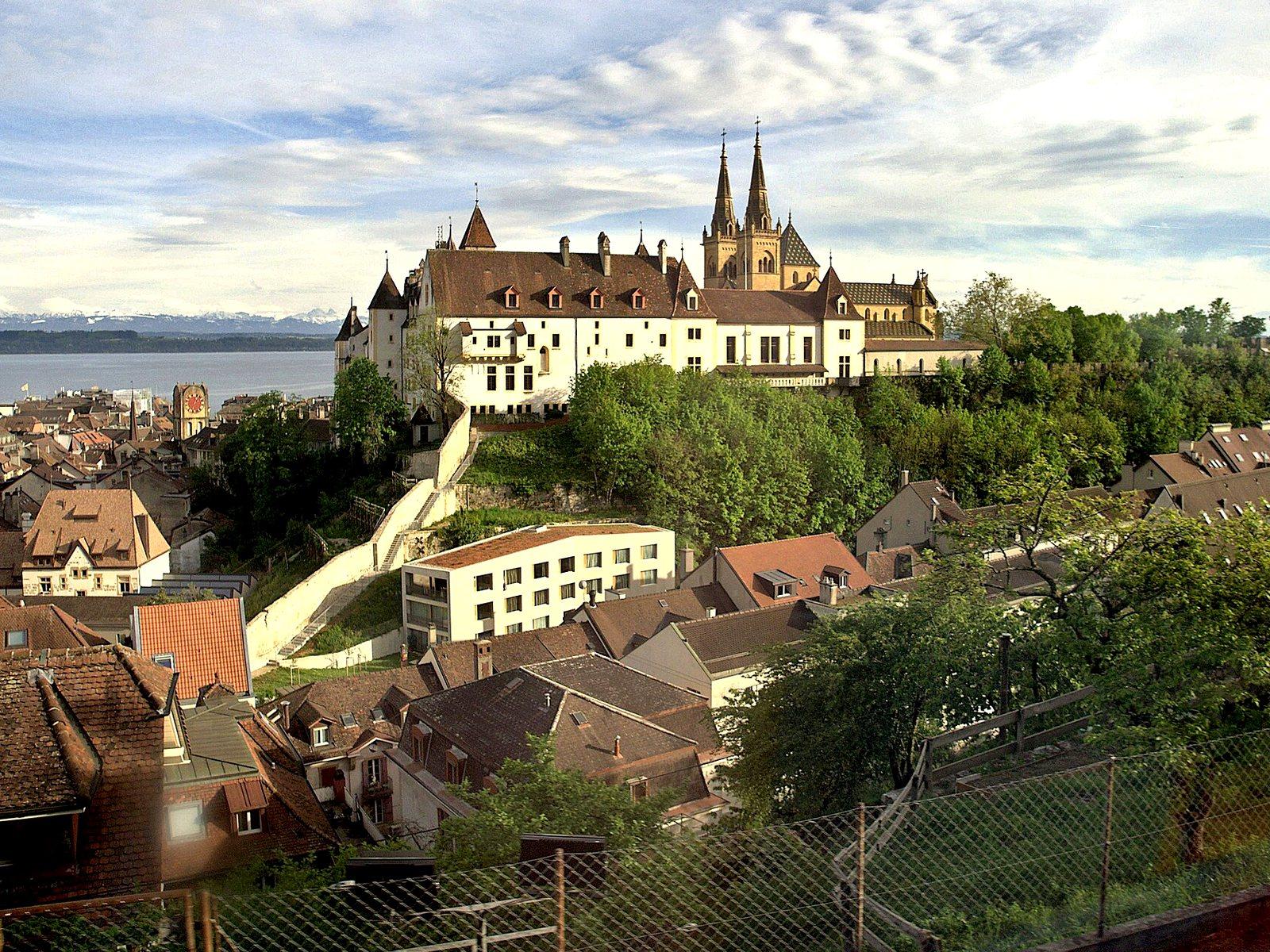
- Neuchâtel, the yellow city: built of Hauterive stone, a yellow limestone, around a castle and a collegiate church that overlook the town. According to Neuchâtel Tourism it has the largest pedestrian zone in Switzerland; the Quai Ostervald, the harbour and the Jeunes-Rives run along the largest lake lying entirely in Switzerland.
- La Chaux-de-Fonds and Le Locle: their watchmaking town planning has been on the UNESCO World Heritage List since 2009. La Chaux-de-Fonds, at 1,000 metres, is laid out as a grid; the Tour Espacité (viewing gallery on the 14th floor) gives an overview. The town is also a centre of Art Nouveau (the “style sapin”) and the birthplace of Le Corbusier, whose Maison blanche (1912) is open at weekends.
- Swiss Capital of Culture 2027: La Chaux-de-Fonds becomes the first Swiss Capital of Culture, with a programme of shows, exhibitions and participatory projects, presented on the Neuchâtel Tourism site.
- The Creux du Van: a rocky amphitheatre more than a kilometre across, with cliffs over 160 m high, ibex and chamois; the 14 hairpin trail climbs it. Dogs are strongly discouraged because of suckler cows.
- The Areuse gorges, from Noiraigue to Boudry; Chaumont, by funicular; the Saut-du-Doubs (a 27 m waterfall, reached by boat from Les Brenets); the Môtiers waterfall, dear to Jean-Jacques Rousseau.
- The pile-dwelling sites: prehistoric lake villages on the UNESCO list, mostly invisible under water, explained at the Laténium in Hauterive.
Museums
| Museum | What you will see |
|---|---|
| Museum of Art and History (MahN), Neuchâtel | Jaquet-Droz automata, sculptures on the Esplanade, the exhibition “À la poursuite du temps” until 3 January 2027 |
| Museum of Ethnography (MEN), Neuchâtel | In a park: about 60,000 objects and 40,000 photographs, with an emphasis on Africa; open Tuesday to Sunday, 10 am to 5 pm |
| Dürrenmatt Centre, Neuchâtel | The painting and writing of Friedrich Dürrenmatt, in a building by Mario Botta |
| Natural History Museum, Neuchâtel | Exhibitions and dioramas; open Tuesday to Sunday, 10 am to 6 pm, free on Wednesdays |
| Laténium, Hauterive | Archaeology and pile-dwelling sites |
| International Watchmaking Museum, La Chaux-de-Fonds | 4,000 pieces, from the sundial to the atomic clock |
| Fine Arts Museum, La Chaux-de-Fonds | A listed Art Deco building; paintings, sculptures and prints of the 19th and 20th centuries |
| Watchmaking Urbanism Space, La Chaux-de-Fonds | Film and exhibition, a starting point for understanding the UNESCO site |
| Watchmaking Museum, Château des Monts, Le Locle | 500 years of watchmaking in an 18th-century mansion |
| Exomusée, Le Locle | An open-air museum: murals and graffiti, free to visit |
| Maison de l'Absinthe, Môtiers | Exhibition route, tasting, shop |
8. Bars, cellars and nights out
No official list of clubs or discos could be read for Neuchâtel: the section relies on the bars listed by Neuchâtel Tourism. The list is not exhaustive: nightlife venues open and close quickly.
| Address | Type | Where |
|---|---|---|
| Café du Cerf | Pub with an “Irish pub” menu and burgers; concerts upstairs on Friday and Saturday evenings | Rue de l'Ancien-Hôtel-de-Ville 4, Neuchâtel |
| La Marina | Pop-up bar with lakeside flavours, at the harbour | Quai du Port 3, Neuchâtel |
| Bar IN OX | Cocktails, champagne, wines, whiskies, cigars | Avenue Léopold-Robert 73, La Chaux-de-Fonds |
9. Festivals and highlights
| Event | When | What it is |
|---|---|---|
| Chocolatissimo | 31 October to 7 November 2026 | Chocolate makers, workshops for children, at the Péristyle of Neuchâtel Town Hall |
| Festin neuchâtelois | 14 March 2027 | A festival announced by Neuchâtel Tourism (programme not read) |
| Open cellar days | 23 and 24 April 2027 | Food and tasting in Neuchâtel (programme not read) |
| Corbak Festival | 13 to 15 May 2027 | A festival created in 1993 in La Chaux-du-Milieu, human in scale |
| Swiss Canyon Trail | 4 to 6 June 2027 | A running race in Couvet, often with more than a thousand runners |
| Festi'neuch | 10 to 13 June 2027 | Contemporary music festival at the Jeunes-Rives: about forty concerts, more than 50,000 festival-goers |
| NIFFF | 2 to 10 July 2027 | Neuchâtel International Fantastic Film Festival |
| Plage des Six Pompes | 2 to 7 August 2027 | Street arts festival in La Chaux-de-Fonds, free entry, artists paid by passing the hat |
| Buskers Festival | Mid-August, five days | About twenty groups play unamplified in Neuchâtel; 2027 date not read |
| Neuchâtel Grape Harvest Festival | 24 to 26 September 2027 | 100th edition |
| La Chaux-de-Fonds, Swiss Capital of Culture | All year 2027 | Shows, exhibitions, performances and participatory projects |
Sources
- Constitution of the Republic and Canton of Neuchâtel (RSN 101), as at 14 June 2026: art. 1, 2, 4, 24, 34a, 37, 39, 40, 41, 42, 47, 52, 53, 66, 67.
- Neuchâtel Statistics Service, statistical portal: population, origin and nationalities; cross-border workers in Q2 2026; politics. Key figures of the 2025 cantonal census (PDF): 131,066 Swiss and 49,236 foreigners.
- State of Neuchâtel, cross-border workers: 1983 agreement, conditions, days without returning, remote work, employer declaration.
- Memento on the 2026 cantonal minimum wage (Employment Service), implementing regulation (RSalMin).
- Site guides, checked against official sources: cross-border tax, G permit, contract and pay (CCNT).
- Neuchâtel Tourism (Jura & Trois-Lacs site): Neuchâtel, La Chaux-de-Fonds, Creux du Van, UNESCO sites, events, Neuchâtel Tourist Card, location and access and the page of each place.
- Swiss Association of PDO-PGI: Neuchâtel saucisson PGI; product list.
- Onde Verte and transN: fares and network.
- Websites of institutions and festivals: MahN, Museum of Ethnography, Dürrenmatt Centre, Natural History Museum, Grape Harvest Festival.
- State of Neuchâtel, foreign labour request form (Migration Service).
- Map coordinates: © OpenStreetMap contributors, checked address by address where the address is known; base map © swisstopo.
Want to work in Neuchâtel?
Browse the canton's job listings, or discover the programme that prepares you for the application, the interview and the employment contract.
Switzerland — all 26 cantons