🇨🇭 Canton guide
Schwyz: living, going out and working in the canton
Everything about the canton of Schwyz: institutions, tax for cross-border workers (outside the 1983 agreement), the Kloster Einsiedeln, the Rigi, the Mythenregion, the Klausjagen, and an interactive map.
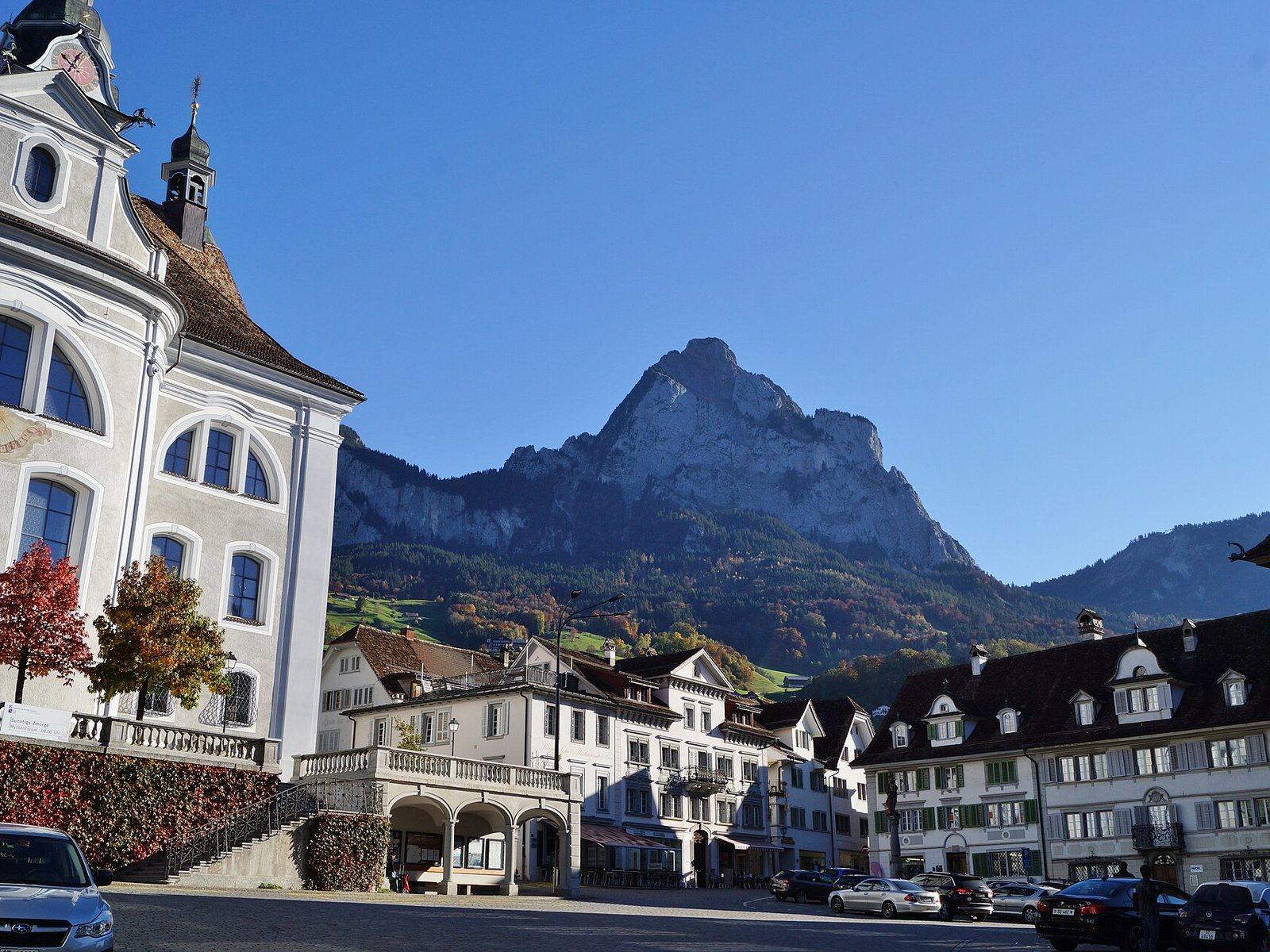
Photo (cropped): FkMohr, CC BY-SA 3.0 DE, via Wikimedia Commons
- residents at the end of 2025 (Federal Statistical Office)
- 170,072
- of the population are foreign nationals (calculated, end of 2025)
- 24.3%
- in Switzerland: the canton is not in the 1983 agreement
- At source
- official language according to the Constitution we read (§ 44)
- German
10 sections≈ 12 min readSources checked on November 6, 2026
The interactive map
33 places marked: landmarks, museums, transport, restaurants, nights out and events. Tap a point to learn more.
Loading the map…
Places on the map (33)
Base map © swisstopo · Places: © OpenStreetMap contributors. When the map appears, your browser loads the tiles from the servers of the Swiss Confederation (swisstopo), which can see your IP address.
Schwyz is a canton in central Switzerland with 170,072 residents, one of the three founding cantons of the Confederation: it gave its name to the country. It runs from the shores of Lake Zurich (March, Höfe) to the Kloster Einsiedeln, the Rigi and the Mythen, and has six districts and thirty municipalities. It has no border with France and is not one of the eight cantons of the 1983 agreement: for a French cross-border worker this means you are taxed at source in Switzerland, on the ordinary scales, and not in France as in Basel or Neuchâtel.
This page gathers what you need to know to live, go out and work in the canton of Schwyz: language, institutions, tax, transport, food, museums, nature, traditions. The figures come from official sources listed at the bottom of the page. Venues open, close and change their hours: always check with them before you travel. The interactive map further down places twelve municipalities and about twenty sites, from Lachen to Gersau. The Constitution we read dates from 2018 and few going-out venues could be read: the page says so.
1. Schwyz at a glance
| Marker | What to know |
|---|---|
| Population | 170,072 residents at the end of 2025 (permanent resident population) |
| Foreign nationals | 41,347 people, or 24.3% |
| Districts (FSO) | March (46,845), Schwyz (59,551), Höfe (30,319), Einsiedeln (16,667), Küssnacht (14,185), Gersau (2,505) |
| Municipalities on the map | Freienbach (17,100), Schwyz (16,735), Einsiedeln (16,667), Küssnacht (14,185), Arth (12,616), Schübelbach (9,919; 34.1% foreign), Ingenbohl (9,599), Lachen (9,448), Wollerau (7,631), Feusisberg (5,588), Muotathal (3,604; 8.2%), Gersau (2,505) |
| Official language | German (§ 44) |
| Parliament | Kantonsrat of 100 members (§ 47); each municipality is a constituency, with at least one seat (§ 48, version we read) |
| Government | Regierungsrat of 7 members, elected by majority vote (§ 56); the Kantonsrat chooses the Landammann and the Statthalter for two years (§ 54) |
| Tax for a French cross-border worker | At source in Switzerland (outside the 1983 agreement), situation deduced |
| Names that come up often | Schwyz, Einsiedeln, Rigi, Mythenregion, Hoch-Ybrig, Küssnacht, Lachen |
The share of foreign nationals is calculated from the Federal Statistical Office table “Permanent resident population” (2025); the figures per district and per municipality come from the same table. The Constitution is dated 24 November 2010; the version we read is the one in the cantonal collection of 3 March 2018.
2. Language
The Constitution we read says the official language is German (§ 44). The official texts we read are in German, and the contract, payslip and forms generally are too; people speak the Alemannic dialect. No main-language statistics were read, so we give no percentage of French speakers. For paperwork, count on German or English; with 24.3% foreign nationals (34.1% in Schübelbach, 31.4% in Freienbach) you will not be the only one not speaking the dialect, but that is not a rule. The tourist pages greet you with “Chömid zuenis”: that is dialect, not an official language.
3. How the canton is governed
| Institution | What the Constitution says (version we read) |
|---|---|
| Right to vote | Swiss citizens aged 18 or over living in the canton (§ 26); they vote and sign initiatives and referendums |
| Elections | Voters choose the Kantonsrat, the Regierungsrat, the Schwyz members of the National Council and the Council of States, and the parliaments and councils of districts and municipalities (§ 27) |
| Kantonsrat | 100 members (§ 47); each municipality is a constituency, with at least one seat (§ 48) |
| Regierungsrat | 7 members elected by majority vote (§ 56); the Kantonsrat designates the Landammann and the Statthalter for two years (§ 54) |
| Terms of office | Four years (§ 43) |
| Popular initiative | 2,000 voters: revision of the Constitution, a law, negotiating treaties (§ 28); the Kantonsrat decides within 18 months |
| Mandatory vote | Constitutional revisions, initiatives rejected by the Kantonsrat, projects with a counter-proposal; laws and spending (above CHF 5 million one-off or CHF 500,000 a year) if the Kantonsrat votes with less than three quarters (§ 34) |
| Optional referendum | 1,000 voters within 60 days (§ 35) |
| Districts and municipalities | The canton is divided into districts and municipalities, autonomous bodies (§ 69-70) |
A cross-border worker has no right to vote in the canton: they vote neither in cantonal or municipal elections nor in votes. This version dates from 2018: the rules for electing the Kantonsrat may have been changed since; check them in the cantonal collection currently in force.
4. Working in Schwyz as a cross-border worker
| Point | What we read |
|---|---|
| 1983 agreement | The Federal Council signed it on behalf of Bern, Solothurn, Basel-Stadt, Basel-Landschaft, Vaud, Valais, Neuchâtel and Jura: Schwyz is not one of them |
| Fribourg tax office | According to its instructions, the agreement “only concerns” these eight cantons |
| Aargau | Its tax office describes the situation in a canton outside the agreement: French cross-border workers taxed on the ordinary scales (A, B, C, H), with a tax credit in France |
| Schwyz tax authority | People without tax residence in Switzerland working for an employer in the canton are taxed at source, subject to double-taxation treaties; cross-border workers and international weekly residents are named; the obligation starts as soon as work begins |
| Scales for Germany | Codes L, M, N, P, Q: maximum rate of 4.5% for “genuine cross-border workers” under the agreement with Germany; no equivalent scale for France is described |
| Employer | Report the job within 8 days, settle within 30 days after the period (month, or quarter for fewer than 10 people), pay the invoice within 30 days; collection commission of 2% |
| Subsequent ordinary assessment (NOV) | A person resident abroad (a cross-border worker) can request it until 31 March of the following year if their situation is comparable to that of a resident (generally at least 90% of family income earned in Switzerland); a representative in Switzerland is needed and the request is valid for one year only |
| Cantonal minimum wage | Not read; check the collective agreement of your sector (see our guide on the CCNT) |
| Number of cross-border workers | Not read |
The details of your case (scale, deduction, 45 days, remote work, health insurance) depend on your situation: follow our guides rather than this page.
5. Getting around
| Means | What we read |
|---|---|
| Arth-Goldau | Bahnhofstrasse 1; departure of the cog railway to the Rigi, valid with the Rigi Bahnen AG day ticket |
| Rigi Bahnen | 1 mountain, 9 lifts; Europe's first mountain railway has run since 21 May 1871; operating holidays and revisions in November |
| Luftseilbahn Kräbel – Rigi Scheidegg | Chräbelstrasse, Oberarth |
| Luftseilbahn Brunnen – Urmiberg | Urmibergweg, Brunnen |
| Seebodenalp | Lift from Küssnacht |
| Stoos | Resort and Stoosbahn at Morschach; stoos.ch is built in the browser and was not read |
| Mythenregion | Webcams at Rotenflue (1,571 m) and Brunni-Alpthal (1,100 m); winter season-pass pre-sale from 1 to 30 November 2026 |
We did not read a detailed network map, timetables or fares. Check your journey on the SBB website before choosing where to live.
6. Eating and drinking
| Place | What we read |
|---|---|
| Mythenregion restaurants | Berggasthaus Holzegg, Berggasthaus Rotenfluh, Gipfelstubli (Rotenflue), Hotel Brunni, Skihaus Holzegg, Passhöhe Ibergeregg |
| Alpine dairies | Alpkäserei Gummen (Brunni-Haggenegg) and Alp- und Hofkäserei Schelbert (Rotenflue) |
| Hoch-Ybrig (summer) | Sternen (1,800 m, 180 indoor seats), Fuederegg (daily 8:30-17:00), Spirstock, Stäfel (1,580 m), Wildä Maa; Laucheren closed in summer 2026 |
| Restaurant Fuederegg | Run by Thomas and Melanie Fuchs since winter 2021/22 |
| Ächt Schwyz | Label of origin and quality for regional products |
| Kloster Einsiedeln Gastwirtschaft | The opening-hours page was out of date: do not rely on it |
No list of valley restaurants was read for this canton and no culinary speciality is cited for lack of a source: better no dish than the wrong one.
7. What to see and do
Einsiedeln, Schwyz and the Rigi
| Place | What we read |
|---|---|
| Kloster Einsiedeln | Benedictine abbey with over 1,000 years of history; abbey church and outdoor areas freely accessible, the rest on tour (Klosterführungen, Monkstrail, scriptorium, DiaVision); most buildings are private (monks, the abbey's secondary school) |
| Bundesbriefmuseum (Bahnhofstrasse 20, Schwyz) | Built in 1936 for the Federal Charter of 1291; Bundesbriefarchiv until 1992, now a history museum |
| Rigi Kulm | “Queen of the Mountains”; Lok 7 exhibition, free, 9:15-16:30 (15:30 in bad weather); steam locomotives over 100 years old |
| Küssnacht | The district's site says the Rigi lies within its territory; “3 Orte, 2 Seen, 1 Berg” |
| Gersau | A district of a single municipality, a “historisches Unikum” and “Dorf des Jahres 2026” according to its site |
The Mythen, Hoch-Ybrig and Lake Zurich
| Place | What we read |
|---|---|
| Rotenflue | 1,571 m; Gämsipark (tower over 7 m high with a slide, rope bridge) and Füchslipfad (30 minutes) |
| Hoch-Ybrig | Ski and hiking area; off-season since 19 October 2026; winter restart end of November 2026 (Stäfel) |
| Lake Zurich | Freienbach, Wollerau, Feusisberg (Höfe) and Lachen, Schübelbach (March): lakeside municipalities, no site described for lack of a source read |
8. Bars, nights out and venues
| Place | What we read |
|---|---|
| MythenForum Schwyz (Reichsstrasse 12) | Film tour on 12 November 2026, comedy Helga Schneider “Ich weiss” on 27 November, Watoto-Kinderchor on 3 December |
| Kino Schwyz (Reichsstrasse 8) | Schwyz's cinema; online programme |
| Musikberg Rigi | Concert calendar of the Rigi region, from yodelling to classical music and techno; 7 November 2026: Karl Jenkins's “Stabat Mater” (AmadeusChor) |
| Illumination Kloster Einsiedeln | 8 to 23 January 2027; evenings of light, Vesper and Komplet |
No list of bars or clubs was read for this canton, and no going-out hours: we kept only the venues whose website we read.
9. Traditions and highlights
| Event | When | What it is |
|---|---|---|
| Martinimarkt (Einsiedeln) | 9 November 2026 | St Martin's fair; the Hauptstrasse is closed from 6 am to 8 pm |
| Küssnachter Klausjagen | 5 December, 8:15 pm; Friday 4 December 2026 this year | Procession of over 1,500 men, up to 30,000 spectators, more than 200 illuminated “Iffele” up to 2.5 m high, Samichlaus, Schmutzli, nearly a thousand Trichler, into the early hours |
| Hoch-Ybrig winter opening | End of November 2026 | According to the Bergrestaurant Stäfel |
| Illumination Kloster Einsiedeln | 8 to 23 January 2027 | The monastery village turned into a world of light and stories; “Tag” package at CHF 85 per person |
| Mythenregion pre-sale | 1 to 30 November 2026 | Winter season passes |
Sources
- Constitution of the canton of Schwyz (100.100): version of 3 March 2018 of the cantonal collection; § 26, 28, 34, 35, 43, 44, 47, 48, 54, 56, 69, 70. Text in German.
- Federal Statistical Office: permanent resident population (table px-x-0102010000_101, 2025): population, foreign nationals, districts, municipalities.
- Agreement of 11 April 1983 on the taxation of cross-border workers; Fribourg tax office: “source tax” instructions; Aargau tax office: leaflet on taxing cross-border workers.
- Schwyz tax authority: Wegleitung zur Quellenbesteuerung (status of 1 January 2026).
- Site guides, checked against official sources: G permit, contract and salary (CCNT).
- Kloster Einsiedeln and its Illumination; Bundesbriefmuseum; Einsiedeln district; Küssnacht district; Küssnachter Klausjagen; Gersau district.
- Rigi: lifts, Lok 7, Musikberg; Mythenregion; Hoch-Ybrig; Restaurant Fuederegg; Bergrestaurant Stäfel; Bergrestaurant Sternen; Ächt Schwyz.
- MythenForum Schwyz; Kino Schwyz; Schwyz Tourismus.
- Map coordinates: © OpenStreetMap contributors; base map © swisstopo.
Want to work in Schwyz?
Browse the canton's job listings, or discover the programme that prepares you for the application, the interview and the employment contract.
Switzerland — all 26 cantons