🇨🇭 Canton guide
Zug: living, going out and working in the canton
Everything about the canton of Zug: institutions, tax for cross-border workers (outside the 1983 agreement), Lake Zug and the Ägerisee, the old town, the Kirschtorte, and an interactive map.
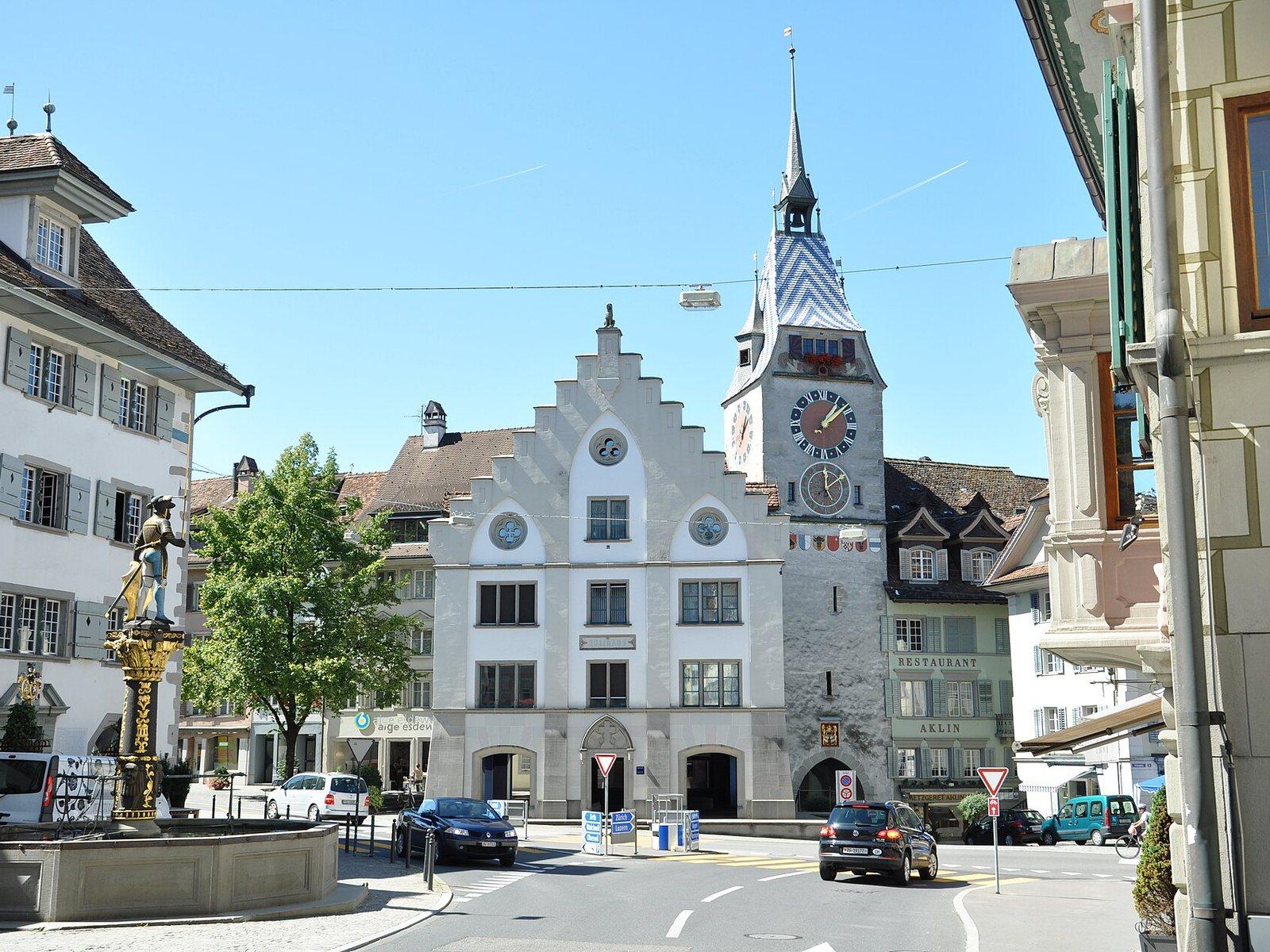
Photo (cropped): Schulerst, CC BY-SA 3.0, via Wikimedia Commons
- residents at the end of 2025 (Federal Statistical Office)
- 135,018
- of the population are foreign nationals (calculated, end of 2025)
- 30.6%
- in Switzerland: the canton is not in the 1983 agreement
- At source
- in the Kantonsrat, elected by proportional representation (Constitution, § 38)
- 80 members
10 sections≈ 12 min readSources checked on November 6, 2026
The interactive map
40 places marked: landmarks, museums, transport, restaurants, nights out and events. Tap a point to learn more.
Loading the map…
Places on the map (40)
Base map © swisstopo · Places: © OpenStreetMap contributors. When the map appears, your browser loads the tiles from the servers of the Swiss Confederation (swisstopo), which can see your IP address.
Zug is a canton of central Switzerland with 135,018 residents, around Lake Zug and the Ägerisee, with an old town on the water, the Zugerberg and the Zuger Kirschtorte. Its capital, Zug, is also the most populous municipality; the canton has eleven municipalities. It has no border with France and is not one of the eight cantons of the 1983 agreement: for a French cross-border worker this means you are taxed at source in Switzerland, on the ordinary scales, and not in France as in Basel or Neuchâtel. The cantonal tax authority's page speaks of cross-border workers (“Grenzgänger”) in general, without naming France: the situation of a French worker is deduced.
This page gathers what you need to know to live, go out and work in the canton of Zug: language, institutions, tax, transport, food, museums, nature, traditions. The figures come from official sources listed at the bottom of the page. Venues open, close and change their hours: always check with them before you travel. The interactive map further down places the eleven municipalities and about thirty sites, from Walchwil to Neuheim.
1. Zug at a glance
| Marker | What to know |
|---|---|
| Population | 135,018 residents at the end of 2025 (permanent resident population) |
| Foreign nationals | 41,347 people, or 30.6% |
| Capital | Zug (32,160 residents, 37.3% foreign), the “Hauptort” and seat of the cantonal authorities (§ 24) |
| Municipalities | Eleven municipalities (§ 24): Zug (32,160; 37.3%), Baar (25,519; 32.2%), Cham (18,518; 27.9%), Risch (11,830; 28.3%), Steinhausen (10,449; 27.1%), Unterägeri (9,527; 27.3%), Hünenberg (8,985; 20.2%), Oberägeri (6,670; 31.1%), Menzingen (4,824; 24.5%), Walchwil (4,013; 36.1%), Neuheim (2,523; 26.2%) |
| Parliament | Kantonsrat of 80 members (§ 38), proportional representation, the municipalities form the constituencies, at least two seats each |
| Government | Regierungsrat of 7 members (§ 45); the Kantonsrat picks its Landammann and Statthalter for two years (§ 46) |
| Tax for a French cross-border worker | At source in Switzerland (outside the 1983 agreement), situation deduced |
| Names that come up often | Zytturm, Zugersee, Zugerberg, Ägerisee, Morgarten, Kirschtorte |
The share of foreign nationals is calculated from the Federal Statistical Office table “Permanent resident population” (2025); the figures per municipality come from the same table. The Constitution is dated 31 January 1894; the version we read has the status of 1 January 2026.
2. Language
The Constitution we read contains no article on the official language, so we do not state one. The official texts we read (Constitution, administration pages, tourism sites) are in German, and the contract, payslip and forms generally are too. No main-language statistics were read, so we give no percentage of French speakers. For paperwork, count on German or English; with 30.6% foreign nationals (over 37% in the town of Zug) you will not be the only one who is not a native German speaker, but that is not a rule. The Zug Tourismus agenda also lists conversation clubs in French, English and Spanish (we only read their titles).
3. How the canton is governed
| Institution | What the Constitution says |
|---|---|
| Right to vote | Swiss citizens aged 18 or over, of the canton or legally settled in it; the cantonal vote is exercised in the municipality of residence (§ 27) |
| Elections at the ballot box | Two members of the Council of States, the Kantonsrat, the Regierungsrat and the cantonal courts; at municipal level the municipal council, the large municipal council and the justice of the peace (§ 78); proportional representation for the Kantonsrat, majority vote for the rest |
| Kantonsrat | 80 members (§ 38); municipalities = constituencies, at least two seats per municipality, seats allocated first among the parties and then among the municipalities (double allocation); it elects its president for two years (§ 40) |
| Regierungsrat | 7 members (§ 45); no member may sit in the federal chambers; Landammann and Statthalter elected for two years (§ 46) |
| Terms of office | Four years for cantonal and municipal authorities; six years for the courts (§ 77) |
| Referendum | 1,500 voters within 60 days against laws and against one-off spending above CHF 500,000 or yearly spending above CHF 50,000; one third of the Kantonsrat can also order a vote (§ 34) |
| Legislative initiative | 2,000 voters; the Kantonsrat deals with it within a year; a vote follows within six months if the Kantonsrat does not accept it (§ 35) |
| Revision of the Constitution | Mandatory popular vote; an initiative follows the rules for legislative initiatives (§ 79) |
| Municipalities | Eleven municipalities; the town of Zug is the capital (§ 24) |
A cross-border worker has no right to vote in the canton: they vote neither in cantonal or municipal elections nor in votes. We found no popular recall in the Constitution we read.
4. Working in Zug as a cross-border worker
| Point | What we read |
|---|---|
| 1983 agreement | The Federal Council signed it on behalf of Bern, Solothurn, Basel-Stadt, Basel-Landschaft, Vaud, Valais, Neuchâtel and Jura: Zug is not one of them |
| Fribourg tax office | According to its instructions, the agreement “only concerns” these eight cantons |
| Aargau | Its tax office describes the situation in a canton outside the agreement: French cross-border workers taxed on the ordinary scales (A, B, C, H), with a tax credit in France |
| Zug page | Source tax is collected through the employer on the earned income of people without a settlement permit living in the canton and of people resident abroad, notably cross-border workers whose place of work is in Switzerland; it mostly affects “foreign nationals without a C permit”; the office audits employers' payroll |
| Scales | 2026 source-tax scales published as PDFs by the administration (for example AN, AY, BN); the office is at Bahnhofstrasse 26, 6300 Zug |
| Nothing on France | The page names no country and does not say whether the 1983 agreement is applied in Zug: deduced from the list of the eight cantons |
| Cantonal minimum wage | Not read; check the collective agreement of your sector (see our guide on the CCNT) |
| Number of cross-border workers | Not read: the canton's statistics pages gave no readable figure |
The details of your case (scale, deduction, 45 days, remote work, health insurance) depend on your situation: follow our guides rather than this page.
5. Getting around
| Means | What we read |
|---|---|
| Zugersee Schifffahrt boats | Lake Zug and the Ägerisee; scheduled boat from mid-April to early November (the season is ending), evening dinner cruises and breakfast buffets in winter; the ships MS Zug and MS Rigi |
| Zugerberg funicular | Eight minutes up to the Zugerberg (1,093 m) |
| S-Bahn | Zug Schutzengel (S1) stop, about ten minutes on foot from the station, next to the exhibition grounds |
| Buses | Bus 606 to “Zug, Stadion”; bus 3, 5, 6 or 11 to “Casino” for the Seebad Seeliken |
| Zug station | Bahnhofplatz; the tourist office is based there |
We did not read a detailed network map, timetables or fares of the fare network. Check your journey on the SBB website before choosing where to live.
6. Eating and drinking
| Place | What we read |
|---|---|
| Hafenrestaurant (Hafenplatz 2) | Café, restaurant, lounge and terrace by the lake; fish specialities, preferably from local lakes; up to 80 people |
| La Colombe, Restaurant zur Taube (Unter Altstadt 26) | Fine dining, Mediterranean cooking with sustainable, regional Slow Food produce; a terrace with sunset views |
| Wirtschaft Brandenberg (Allmendstrasse 3) | An inn over 100 years old, traditional cooking, more than 400 wines from around the world; up to 100 people |
| Restaurant Raten (Oberägeri, 1,077 m) | Excursion restaurant above the Ägerisee, a rustic beizli and a large terrace, a large playground; up to 100 people |
| Kaffeehaus Treichler (Bundesplatz 3) | Home of the Zuger Kirschtorte (Heinrich Höhn, 1913); the Zuger Kirschtorten Museum (more than 200 items) is free during shop hours; the cake is on the inventory of Switzerland's culinary heritage |
| Cherry specialities | Zuger Kirschwasser, Chriesiwurst (grilled, boiled or raw), fresh cherries sold on the Landsgemeindeplatz in season and at farm shops (Biohof Zug, Letzihof Zug, Hof Märcht) |
No exhaustive list of valley restaurants was read for this canton: we kept only venues whose page we read.
7. What to see and do
The old town of Zug
| Place | What we read |
|---|---|
| Zytturm | 41.5 m, the town's emblem; an astronomical clock with four hands; daily 10-18 (last entry 17:30), access with the eZug app or a badge |
| Kolinbrunnen | Fountain from 1541, restored in 1747; nobody knows who the statue shows |
| Museum Burg Zug | Medieval castle turned museum, exhibition “hûs, stat, fëld – Mittelalter in der Zentralschweiz”; hours not read |
| Kunsthaus Zug | About 10,000 works; the exhibition “Chamber, Chamber” from 24 October 2026 to 7 February 2027 |
| Museum für Urgeschichte(n) | Hofstrasse 15; finds from the pile dwellings (UNESCO sites); free entry on Sundays and public holidays |
| Aussichtspunkt Guggi | A few steps uphill behind the post office; a view of the old town, the lake and the Alps |
| Seebad Seeliken | Lake lido; season from Mother's Day to the Bettag |
Lakes, mountain and history
| Place | What we read |
|---|---|
| Zugerberg | 1,093 m, summer and winter trails, the Zugiblubbi adventure trail |
| Ägerisee | “The pearl of the canton”, the Ägerital-Sattel region |
| Morgarten-Denkmal | Battle of November 1315; 112th Morgartenschiessen on Sunday 15 November 2026, the largest historical shoot in Switzerland |
| Höllgrotten (Baar) | Caves 6,000 years old; open from April to October, so closed at the moment |
| Ziegeleimuseum (Hagendorn, Cham) | Brick museum with an adventure area; one-hour tours (CHF 200 to 300 a group) |
8. Bars, nights out and venues
| Place | What we read |
|---|---|
| Skylounge (General-Guisan-Strasse 6) | Bar on the 18th floor of the Uptown building, 65 m up; cocktails, wines by the glass, snacks; hours not read |
| Mantra Cafe & Bar (Alpenstrasse 14) | Café and bar for a drink, after-work or a party; hours not read |
| 67 Sixtyseven Sportsbar (OYM hall) | Live games from Tuesday to Sunday; EVZ fans meet there on match days |
| Theater Casino Zug | Theatre from 1909; 2026/27 season “End-Spiel” (drama, music, dance, comedy, contemporary circus) |
| Jazz Night Zug | 19 to 21 August 2027, jazz, blues and swing in the old town |
No list of clubs was read for this canton, and no going-out hours: we kept only the venues whose page we read.
9. Traditions and highlights
| Event | When | What it is |
|---|---|---|
| Morgartenschiessen | Sunday 15 November 2026 | 112th historical shoot at the Morgarten-Denkmal; spectators welcome |
| Herti Zauber | 6 November 2026 to 21 February 2027 | Ice rink and Fondue Chalet on the Arenaplatz, in front of the OYM hall |
| Bäckermöhli | Wednesday 27 January 2027 | A culinary tradition since 1688 |
| Zug Fasnacht | From Fat Thursday to Shrove Tuesday 2027 (exact dates not read) | Starts at 5 a.m. sharp with the Chesslete; guggenmusigen; children's parade on the Kolinplatz |
| Chrööpfelimee | Sunday 14 February 2027 | A traditional custom of the town |
| Chriesisturm | June (2027 date not known) | A cherry-picking race with ladders through the old town, since 2009 |
| Jazz Night Zug | 19 to 21 August 2027 | Three days of concerts in the old town |
| Stierenmarkt | 8 and 9 September 2027 | A bull market, a heavily attended farming event |
Sources
- Constitution of the canton of Zug (BGS 111.1): status of 1 January 2026; § 24, 27, 34, 35, 38, 40, 45, 46, 77 to 79. Text in German.
- Federal Statistical Office: permanent resident population (table px-x-0102010000_101, 2025): population, foreign nationals, municipalities.
- Agreement of 11 April 1983 on the taxation of cross-border workers; Fribourg tax office: “source tax” instructions; Aargau tax office: leaflet on taxing cross-border workers.
- Canton of Zug: Quellensteuer and source-tax scales.
- Site guides, checked against official sources: G permit, contract and salary (CCNT).
- Zug Tourismus: Zytturm, Kolinbrunnen, Kunsthaus Zug, Museum für Urgeschichte(n), Zugerberg, Ägerital-Sattel, Morgarten, Höllgrotten.
- Zug Tourismus: food and nights out: Hafenrestaurant, Restaurant zur Taube, Wirtschaft Brandenberg, Restaurant Raten, Kaffeehaus Treichler, Skylounge, Theater Casino.
- Zug Tourismus: events: Fasnacht, Chriesisturm, Jazz Night, Herti Zauber, Stierenmarkt, Zuger Messe.
- Map coordinates: © OpenStreetMap contributors; base map © swisstopo.
Want to work in Zug?
Browse the canton's job listings, or discover the programme that prepares you for the application, the interview and the employment contract.
Switzerland — all 26 cantons